

The way people give is changing. Donors are giving from their phones, signing up for monthly contributions, discovering causes through social media creators, and expecting the same seamless digital experiences they get from every other part of their lives. For nonprofits, this shift is not a threat. It is an opportunity.
The good news? You do not need blockchain, virtual reality headsets, or experimental technology to take advantage of these trends. The fundraising ideas that are actually driving results right now are practical, proven, and accessible to organizations of every size.
This guide covers five fundraising strategies that are working for nonprofits today, backed by current data and designed to help you raise more, engage more supporters, and build a stronger financial foundation for your mission.
1. Make Monthly Giving the Default, Not the Afterthought
If there is one fundraising trend that deserves your immediate attention, it is recurring giving. Monthly donations have quietly become one of the most powerful revenue engines in the nonprofit sector.
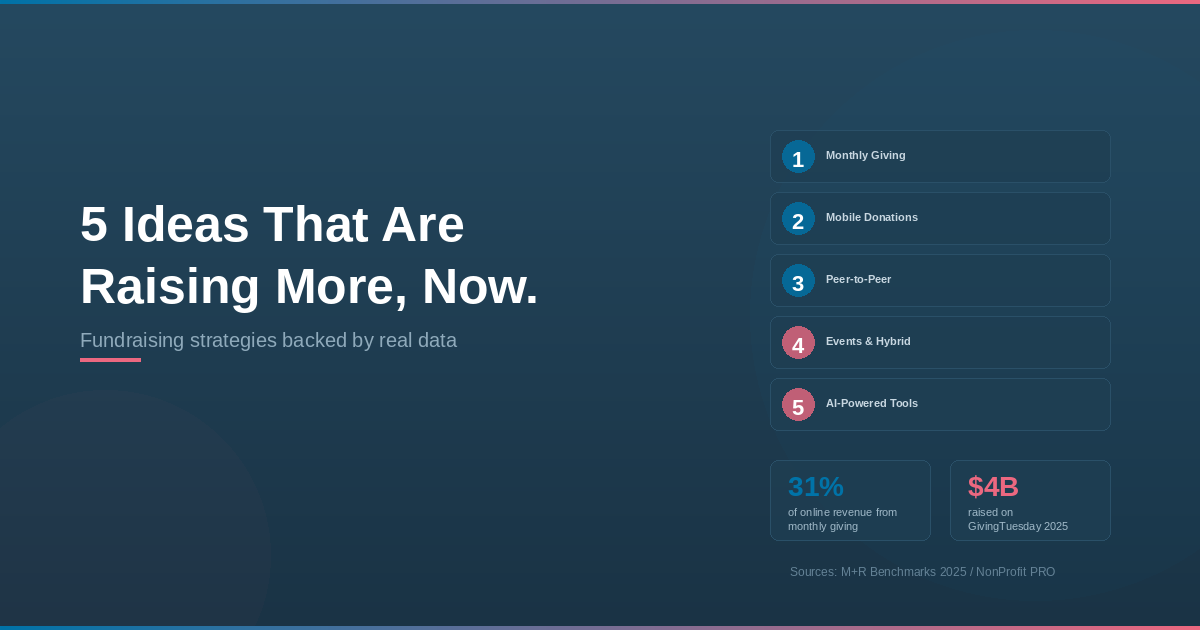
According to the 2025 M+R Benchmarks Study, monthly giving now accounts for 31% of all online nonprofit revenue, and recurring gift revenue grew 5% in 2024 while one-time giving remained flat. The average monthly donor gives $24 per month, which adds up to $288 per year, significantly more than the average one-time gift of $126.
Even more important: monthly donors stick around. Research shows that the average recurring donor stays with an organization for more than eight years, compared to just 1.68 years for one-time donors.
Yet the M+R study found that 64% of nonprofits still default their donation pages to one-time gifts. That is a missed opportunity.
Here is how to make monthly giving work harder for you:
– Default your donation page to recurring giving. Only 35% of nonprofits currently pre-select monthly giving as the default option. A simple change to your donation form can meaningfully increase sign-ups.
– Name your monthly giving program. Give it an identity that donors can feel part of, like “The Changemakers Circle” or “The Sustainer Community.”
– Show the annual impact. Instead of just asking for $25 a month, show donors what $300 a year accomplishes: “Your $25/month provides school supplies for 6 students for an entire year.”
– Send regular updates to monthly donors. These supporters are your most loyal base. Keep them engaged with exclusive impact updates and behind-the-scenes content.
2. Meet Donors on Their Phones
Mobile giving is no longer a nice-to-have. It is where a growing share of donations happen.
In 2024, 45% of all online donations were made on a mobile device. And with SMS open rates near 98%, text-to-give campaigns put your fundraising appeals directly in donors’ hands, where they are almost certain to be seen.
The M+R Benchmarks Study also found that nonprofits now support multiple digital payment methods: 76% accept PayPal, 47% accept Apple Pay, and 40% accept Google Pay. Making it easy for donors to give the way they prefer removes friction and increases conversion.
Here is what a mobile-friendly fundraising approach looks like:
– Ensure your donation page is fully optimized for mobile. Desktop gifts average $145, while mobile gifts average $76, but mobile volume is growing fast.
– Accept digital wallets. Apple Pay, Google Pay, and PayPal let donors complete a gift with a single tap. Fewer steps mean fewer abandoned donations.
– Use text-to-give for campaigns and events. A simple “Text GIVE to 55555” at a fundraising event or on social media makes donating effortless.
– Keep your forms short. The fewer fields a donor has to fill in, the more likely they are to complete their gift.
Nonprofit Tech for Good reports that 55% of donors will cover credit card processing fees if given the option. Adding a simple checkbox to your donation form can recover thousands of dollars in fees each year.
3. Turn Your Supporters Into Fundraisers
Peer-to-peer fundraising lets your most passionate supporters raise money on your behalf by reaching out to their own networks. It is one of the most effective ways to expand your reach without expanding your budget.
The 2025 M+R Benchmarks Study found that peer-to-peer campaign volume rose 18% in 2024, with a strong 76% activation rate among registered participants. The approach works because people trust recommendations from friends and family far more than they trust appeals from organizations they do not know.
GivingTuesday 2025 demonstrated the power of community-driven giving on a massive scale. Americans donated $4 billion on a single day, with 38.1 million people participating. Beyond financial contributions, 11.1 million people volunteered, a 20% increase, and 20.9 million spoke out about causes they care about, a 26% increase.
There is also a generational shift worth paying attention to: 61% of Gen Z donors say a creator’s involvement makes them more likely to donate to charity. About half of nonprofits in the M+R study now work with social media influencers, with 60% of those using paid partnerships specifically for fundraising.
How to build a peer-to-peer fundraising strategy:
– Create a dedicated campaign page that supporters can personalize and share with their networks.
– Give fundraisers the tools they need: sample social media posts, email templates, and impact statistics they can use to make the case for your cause.
– Celebrate and recognize top fundraisers publicly. Recognition motivates continued participation.
– Consider partnering with micro-influencers or content creators who align with your mission. You do not need celebrities. Authentic voices with engaged audiences can drive significant results.
4. Use Events as a Revenue Engine (In Person, Virtual, or Both)
Fundraising events are not just surviving in the digital age. They are thriving. And the most successful nonprofits are using a mix of in-person, virtual, and hybrid formats to reach more supporters than ever.
A 2025 survey found that 77% of nonprofits met or exceeded their event fundraising goals, with organizations that held in-person events performing strongest at 80%. But here is a telling counterpoint: nearly half (46%) of organizations that did not hold any events raised less than they budgeted for.
Hybrid events, which combine an in-person experience with virtual participation, are opening new possibilities. By adding a livestream or virtual auction component to a gala or dinner, nonprofits can engage supporters who cannot attend in person, including donors in other cities or even other countries. One organization raised 40% more than its fundraising target by running a hybrid gala where remote participants joined via livestream and participated in a synchronized auction alongside in-person attendees.
Tips for maximizing your fundraising events:
– If you are only doing in-person events, consider adding a virtual component to expand your reach.
– Use event registration as a donor acquisition opportunity. Collect contact information and follow up with attendees who have not donated before.
– Integrate mobile bidding for auctions and text-to-give during live events to make giving seamless.
– Follow up within 48 hours with a thank-you, event highlights, and a clear next step for staying involved.
– Track event ROI carefully. Giving USA notes that smart event fundraising is crucial in an era of shrinking budgets, and nonprofits should evaluate which event formats deliver the best return on investment.
5. Let AI Handle the Busywork So You Can Focus on Relationships
Artificial intelligence is not here to replace your fundraising team. It is here to save them time on repetitive tasks so they can spend more energy on what matters most: building genuine relationships with donors.
The numbers show this is already happening. According to the 2025 M+R Benchmarks Study, 78% of nonprofits now use generative AI for marketing, fundraising, or advocacy. And 67% of online donors say they are comfortable with nonprofits using AI for marketing and fundraising tasks.
The most practical applications of AI for nonprofit fundraising right now include:
– Drafting donor communications. AI can help write first drafts of thank-you emails, appeal letters, and social media posts, which your team then personalizes and refines. The top use cases are grammar checking (53%), brainstorming headlines (53%), and drafting content (39%).
– Optimizing donation forms. AI-optimized donation forms average $161 per one-time gift compared to the $115 industry average, and $32 per monthly gift compared to $24.
– Donor research. 82% of fundraisers are comfortable using AI for donor research, even if they are more cautious about using it for direct communications.
– Grant writing support. Nearly 25% of nonprofits already use AI to help streamline grant writing, freeing up staff time for other priorities.
A word of caution: 30% of nonprofits report that AI has boosted their fundraising revenue, but only 7% say it has delivered major organizational improvements. The nonprofits seeing the best results are the ones using AI as a tool to support their team, not as a replacement for human connection. Only 42% of nonprofits using AI have formal policies in place, so if you are exploring AI, take the time to set guidelines for your team.
How a CRM Ties It All Together
Each of these five strategies works better when your data, communications, and donor relationships are connected in one place. A nonprofit CRM acts as the hub that makes it all manageable.
Here is what the right CRM helps you do:
– Manage recurring giving programs and track monthly donor retention and lifetime value.
– Capture and organize donor data from mobile giving, events, and peer-to-peer campaigns.
– Segment donors for personalized outreach based on giving history, interests, and engagement patterns.
– Plan and track fundraising events from registration to follow-up, all in one system.
– Generate reports that show which fundraising strategies are delivering the best return.
GiveLife365 is a nonprofit CRM built on the Microsoft Power platform that brings donor management, volunteer coordination, event management, membership tracking, case management, and impact reporting together in one system. Whether you are launching a monthly giving program, running a hybrid gala, or using AI to streamline your outreach, GiveLife365 gives your team a single dashboard to manage it all.
The Best Fundraising Ideas Are the Ones You Actually Use
You do not need to chase every new technology trend. The nonprofits seeing the strongest fundraising results in 2025 and 2026 are the ones that focus on proven strategies, executed well and supported by the right tools.
Start with the idea that makes the most sense for your organization right now. Maybe that is switching your donation page to default to monthly giving. Maybe it is launching your first peer-to-peer campaign. Maybe it is finally optimizing your donation page for mobile.
Whatever you choose, the key is to start, measure your results, and build from there.
Ready to put these fundraising ideas into action? Book a free demo of GiveLife365 and see how a nonprofit CRM can help your team raise more, engage more supporters, and spend less time on admin.
