

Here is a reality most nonprofit leaders quietly worry about: you spend months building relationships, running campaigns, and convincing someone to make their first gift. Then the next year rolls around, and most of those donors are gone.
If you have felt that frustration, you are not alone. According to the latest Fundraising Effectiveness Project Q3 2025 report, the average donor retention rate across nonprofits sits at just 31.9%, and only 14% of first-time donors return to give again. That means roughly seven out of every ten donors will not be back next year.
The good news? Donor retention is one of the most powerful levers any nonprofit can pull. Small improvements can create huge results, both for your bottom line and for your mission. And the strategies that work are not complicated. They just require a bit of planning, the right tools, and genuine care for your supporters.
Let us walk through what donor retention really is, why it matters so much, and the specific strategies that bring donors back year after year.
What Is Donor Retention?
Donor retention is simply the percentage of donors who give to your organization again within a certain period, usually one year. If 200 of the 300 people who donated to your nonprofit last year gave again this year, your retention rate is about 66%.
It is one of the most telling numbers in nonprofit fundraising. High retention means your donors feel connected, informed, and valued. Low retention often means something in the donor experience is missing, whether that is communication, appreciation, or a clear sense of impact.
Why Donor Retention Matters More Than Ever
Every dollar you raise depends on people who choose to give. Here is why focusing on retention is one of the smartest moves your nonprofit can make.
1. Keeping a donor is far cheaper than finding a new one
Acquiring a new donor takes serious time and money. You need to build awareness, run campaigns, design materials, and cultivate trust before someone is ready to give. Meanwhile, retained donors already trust you. They know your cause. They need far less convincing to give again. Multiple nonprofit studies have consistently shown that acquiring a new donor costs several times more than retaining an existing one.
2. Loyal donors tend to give more over time
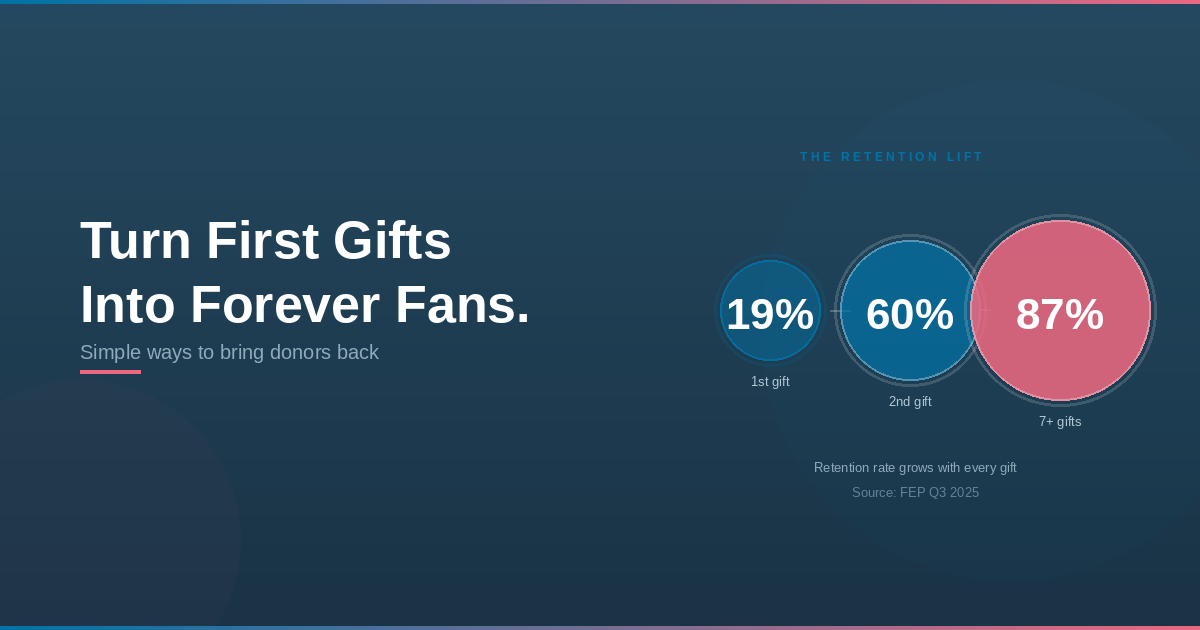
Donors who give repeatedly tend to give larger amounts. The data makes this crystal clear. According to the Fundraising Effectiveness Project, one-time donors have a retention rate of 19.2%, two-time donors jump to 38.5%, donors who have given three to six times retain at 62.5%, and donors with seven or more gifts retain at an incredible 87.3%. Each additional gift deepens the relationship and increases lifetime value.
3. Happy donors become advocates for your cause
When donors feel valued, they do not just give again. They also share your mission with friends, family, and their professional networks. That word-of-mouth support is often more powerful than any ad campaign, and it comes at no extra cost to your organization.
The Most Critical Moment: The Second Gift
If there is one stat that should shape your entire retention strategy, it is this: only 14% of first-time donors give a second gift, but once they do, roughly 60% of those donors continue giving long into the future.
In other words, the second gift is the turning point. It is what turns a one-time supporter into a long-term champion. Everything in the first 90 days after a donor’s first gift should be designed to earn that second gift.
A helpful framework to keep in mind:
– Send a heartfelt thank-you within 48 hours
– Share the impact of their gift within 30 days
– Make a second meaningful touchpoint within 90 days
Done well, this simple rhythm can meaningfully shift your retention numbers.
How to Measure Your Donor Retention Rate
Before you can improve your retention, you need to know where you stand. The formula is straightforward:
(Number of donors this year who also gave last year) divided by (Total number of donors last year), multiplied by 100.
Example: If 200 out of 300 donors returned to give again, your retention rate is 66%.
This is where a good nonprofit CRM really helps. Managing donor records in spreadsheets works when you are small, but as your donor base grows, it becomes hard to keep track of who gave when, what they care about, or whether a regular supporter has gone quiet. A CRM like GiveLife365 automatically tracks donor activity, calculates retention metrics, and surfaces patterns you would otherwise miss.
7 Donor Retention Strategies That Actually Work
Here are the retention strategies that today’s top-performing nonprofits are using. You do not need to do all of them at once. Pick one or two, start there, and build from there.
1. Personalize every communication
Donors want to be seen as individuals, not entries in a mailing list. The research backs this up. Personalized email subject lines get opened 26% more often, and personalized calls to action convert 202% better than generic ones, according to Nonprofit Tech for Good.
A few easy ways to personalize:
– Always use the donor’s name, not “Dear Friend”
– Reference their past giving or involvement
– Segment your list so donors hear about the programs they actually care about
– Send a personalized thank-you note after each gift
A CRM makes this much easier because all the donor information lives in one place, so personalizing at scale is genuinely possible, even for small teams.
2. Thank donors quickly and meaningfully
A thank-you is not a formality. It is the beginning of the next gift. Send a prompt, sincere thank-you within 48 hours of every donation. Better yet, go beyond the automated email. Pick up the phone. A short call that says, “I just saw your gift come through, and I wanted to thank you personally,” costs nothing but can make a lasting impression. Candid’s donor stewardship guidance emphasizes exactly this kind of consistent, thoughtful outreach as one of the most effective ways to build long-term loyalty.
Handwritten notes, especially for midsize and major donors, are another small gesture that punches well above its weight.
3. Show donors the impact of their gift
One of the fastest ways to lose donors is to make them feel like their money disappeared into a black hole. Donors want proof that their gift made a difference. Research shows that impact reporting is one of the most powerful retention tools a nonprofit has.
This is a core theme in Candid’s donor stewardship guidance: data provides credibility, but stories create connection, and used together they build the kind of trust that keeps donors engaged. Share specific stories. Send updates with photos and real numbers. Something as simple as “Your gift helped us serve 43 families this month” is far more powerful than “Thanks for your donation.”
Transparency also matters. Candid’s guidance on meaningful donor engagement encourages nonprofits to share both wins and challenges, because honesty about struggles builds more trust than glossing over them.
4. Educate, do not just ask
Donors who understand your mission deeply are more likely to stay with you for the long haul. Do not only reach out when you need money. Share educational content that helps them understand the issues you work on, the communities you serve, and the difference your programs are making.
Use your newsletter, blog, and social media to educate, inspire, and update. When a donor feels like an insider rather than a target, they stick around.
5. Offer multiple ways to give and engage
Not every donor wants to engage the same way. Some prefer monthly giving. Others want to volunteer. Some might be a good fit for a board role, an advocacy campaign, or a peer-to-peer fundraiser.
Give your supporters options. Monthly giving is especially powerful right now. According to the 2025 M+R Benchmarks Study, monthly giving revenue grew 5% in 2024 and now accounts for 31% of all online nonprofit revenue. And the average recurring donor sticks with an organization for more than eight years, compared to just 1.68 years for one-time donors, according to the 2025 Recurring Giving Benchmark Study.
If you are not already promoting a monthly giving program, this is one of the highest-impact changes you can make.
6. Ask for feedback and listen
Donors notice when you ask for their opinion. A short survey once or twice a year, or even just informal outreach to top supporters, can reveal what is working and what is not. Ask why they support your cause, what kind of updates they value most, and how you could communicate better.
The organizations that grow fastest in 2026 will be the ones that treat donors as partners, not just funders. Candid’s donor engagement research encourages nonprofits to position donors as thought partners, invite their input, and build genuine two-way relationships rather than one-sided asks.
7. Invite donors deeper into your mission
Give loyal donors opportunities to engage beyond writing a check. Invite them to events, behind-the-scenes tours, volunteer days, or small gatherings with your team. Candid’s donor engagement research highlights that today’s donors, especially Gen X and millennials, want authentic connection and opportunities for meaningful involvement beyond traditional giving.
When donors feel like they are part of something, they stay.
Where a CRM Fits In
Every strategy on this list gets easier and more effective with the right technology behind it. A CRM built for nonprofits lets you:
– Track every interaction with every donor in one place
– Automatically send timely thank-yous and impact updates
– Segment donors so your outreach actually lands
– Monitor retention rates and spot at-risk donors before they lapse
– Automate recurring giving and membership renewals
– Save hours of admin time each week
GiveLife365 is a nonprofit CRM designed specifically for these workflows. Built on the Microsoft Power platform, it brings donor management, volunteer tracking, event management, membership, and impact reporting into a single, easy-to-use system. Instead of juggling spreadsheets or disconnected tools, your team can focus on the work that actually keeps donors coming back.
Small Changes, Big Results
Here is the encouraging truth about donor retention: you do not need to overhaul everything at once. Most nonprofits see meaningful improvements by focusing on just two or three of these strategies consistently. A faster thank-you. A better impact update. A thoughtful phone call. Small, steady changes add up.
The nonprofits winning in 2026 are the ones that treat donor retention not as an afterthought, but as a core part of their mission work. When you invest in your existing donors, you build a stable, loyal base that makes everything else, from major gifts to new donor acquisition, easier.
Ready to see how a nonprofit CRM can simplify donor retention for your team? Book a free demo of GiveLife365 and find out how the right tools can help you keep more of the donors you work so hard to earn.
