

When a donor gives to your nonprofit, they are placing a bet on your ability to make a difference. They want to know: Did my gift matter? What changed because of my support? These are fair questions, and the nonprofits that answer them clearly and consistently are the ones that keep donors coming back, attract new funders, and earn the trust of their communities.
That is what impact reporting is all about. It is the practice of measuring what your organization accomplishes, not just what it does, and communicating those results in a way that is honest, clear, and compelling.
This guide will walk you through why impact reporting matters more than ever, what donors and funders actually expect, and how to build a practical impact reporting process that strengthens your nonprofit from the inside out.
Why Impact Reporting Matters Now More Than Ever
Nonprofits have always been asked to show where the money goes. But in recent years, the expectations around transparency and accountability have shifted dramatically.
Donors want proof of impact, not just activity
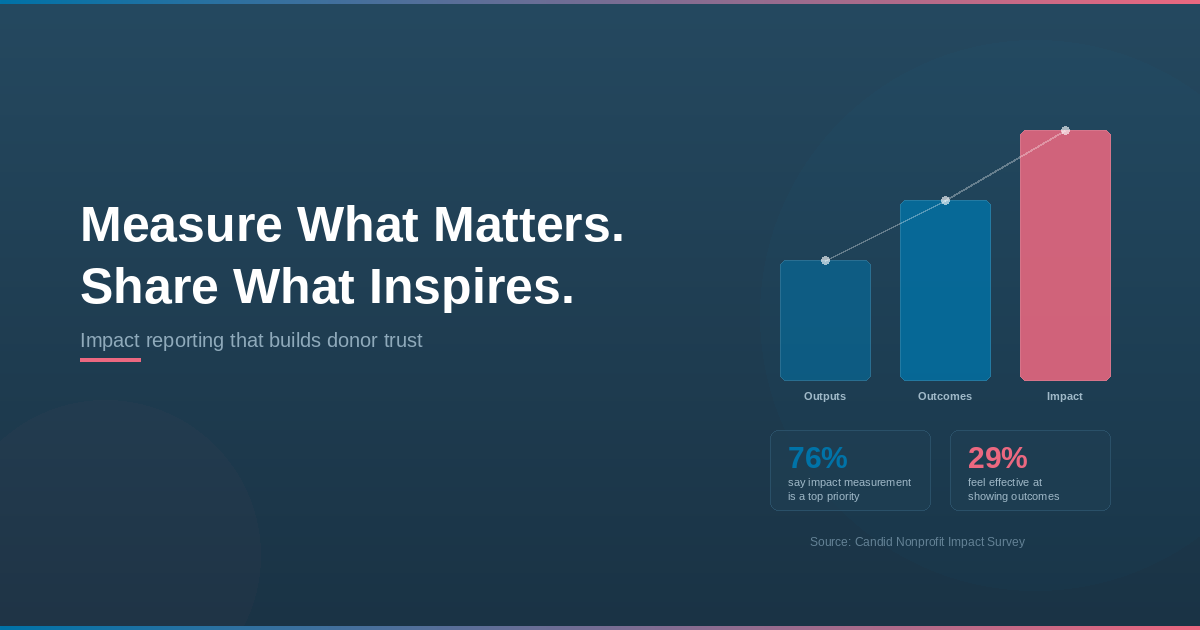
It used to be enough to tell donors how many people you served or how many events you hosted. Those are outputs, and they still matter. But today’s donors, especially younger generations, want to see outcomes: the actual changes your programs create in people’s lives.
A survey of 355 nonprofit decision-makers found that 76% identified impact measurement as a top priority. Yet only 29% felt they were “very effective at demonstrating outcomes”. That gap represents both a challenge and an opportunity for nonprofits willing to invest in better reporting.
NonProfit PRO reports that today’s donors have evolved beyond relying on emotional stories and personal relationships alone. They now expect organizations to demonstrate meaningful outcomes through data and transparency. Strong impact reports treat donors as investors who expect a clear return on their investment, measured not in profit, but in social change.
Trust depends on transparency
The Give.org Donor Trust Report found that the top three accountability priorities for donors are: how a charity spends its money, whether fundraising appeals are honest, and protection of donor information. When a nonprofit can clearly show how contributions translate into real-world outcomes, it addresses the first two of those priorities head on.
In 2024, charitable giving in the United States reached $592.5 billion, a 4.2% increase when adjusted for inflation. But with only 19% of first-time donors returning to give again, the competition for donor loyalty is intense. Demonstrating impact is one of the most effective ways to stand out and build lasting relationships.
Funders increasingly require it
Beyond individual donors, institutional funders and government grant programs are raising the bar on reporting requirements. Under the U.S. federal Uniform Guidance (2 CFR Part 200), grantees must provide performance progress reports aligned to approved logic models, not just financial statements. Funders want to see pre-and-post comparisons, disaggregated data, and evidence of change, not just summaries of activities.
The message is clear: whether your support comes from individual donors, foundations, or government grants, impact reporting is no longer optional.
Understanding the Difference: Outputs vs. Outcomes vs. Impact
One of the most common mistakes nonprofits make is confusing outputs with outcomes. Understanding the difference is the foundation of effective impact reporting.
Outputs are the immediate, countable results of your activities. For example: “We served 2,500 meals” or “We trained 150 participants.” These numbers tell you what you did, but they do not tell you what changed as a result.
Outcomes are the changes that happen because of your work. For example: “85% of program participants reported improved food security” or “72% of training graduates found employment within six months.” Outcomes measure the difference your programs actually make.
Impact is the broader, long-term change your work contributes to. For example: “Childhood hunger in our county decreased by 12% over three years.” Impact connects your organization’s work to larger societal shifts.
Candid recommends that nonprofits build a logic model that maps the path from inputs (resources) to activities to outputs to outcomes to impact. This framework helps you define what success looks like for each program and identify the right metrics to track along the way.
How to Build an Impact Reporting Process: 5 Practical Steps
You do not need an expensive consulting firm or a dedicated data team to start reporting on your impact. Here are five practical steps any nonprofit can follow.
1. Define what success looks like for each program
Before you can measure impact, you need to know what you are trying to achieve. For each of your programs, ask: What specific change are we trying to create? How will we know if we have succeeded?
Write these down as clear, measurable outcome statements. For example, instead of “help families in need,” try “increase the percentage of participating families who achieve stable housing within 12 months.”
Candid’s impact measurement framework suggests starting with the question “What does success look like?” and then working backward to define the data you need to collect to track your progress toward that goal.
2. Collect both numbers and stories
Effective impact reports use two types of data working together. Quantitative data, your numbers and statistics, provides credibility and scale. Qualitative data, the stories and testimonials from the people you serve, provides the human connection that makes numbers meaningful.
For example, you might report that your after-school program improved reading scores for 78% of participants (quantitative), and then share the story of one student whose confidence transformed over the course of the year (qualitative). Together, they paint a complete picture.
As Candid advises, quantitative data lets you make quick calculations, while qualitative data provides the context that brings those calculations to life.
3. Track outcomes over time, not just at a single point
A single snapshot of results tells part of the story, but tracking outcomes over time reveals trends, progress, and areas that need attention. Did your program outcomes improve from last year? Are there patterns in who benefits most? Where are the gaps?
The Salvation Army Indiana Division provides a good example of this in action. Their inaugural impact report tracked metrics like 2.59 million meals served and 296,897 individuals receiving basic social services in a single year, creating a baseline they can measure future performance against.
Consistent tracking also makes grant reporting much easier, because you have the data ready rather than scrambling to compile it at reporting time.
4. Make your reports visual and accessible
An impact report does not have to be a 40-page PDF that nobody reads. In fact, the most effective reports are often the simplest ones. Use clear charts, infographics, and short narrative sections to communicate your results.
The National Council of Nonprofits recommends that annual reports should be visually compelling, underscore your organization’s commitment to transparency, and clearly explain your mission, progress, and outcomes. The goal is to make your impact easy to understand at a glance, whether someone reads the full report or just skims the highlights.
A few formats that work well: a one-page visual summary for email, a short video highlighting key results, an interactive dashboard on your website, or a printable version for events and meetings.
5. Share your results widely and regularly
Impact reporting is not just for your annual report. Share results throughout the year through email updates, social media posts, newsletter features, and donor thank-you communications. Regular updates keep donors connected to your mission and reinforce the value of their support.
According to Nonprofit Tech for Good, 33% of donors say email is the tool that most inspires them to give. Imagine the power of a monthly email that does not just ask for a donation, but shares a specific outcome that donors helped make possible.
The Role of Technology in Impact Reporting
Technology is making impact reporting more accessible and more powerful for nonprofits of every size.
Making data collection easier
A nonprofit CRM can centralize your program data, donor information, and volunteer activity in one place, making it far easier to connect inputs to outcomes. Instead of pulling data from spreadsheets, email threads, and separate databases, you can generate reports from a single system.
AI is entering the picture
Artificial intelligence is beginning to change how nonprofits approach data and reporting. The TechSoup and Tapp Network 2025 State of AI in Nonprofits benchmark report found that 92% of surveyed nonprofits are using AI tools in some capacity. However, only 24% have moved beyond exploration into active implementation, and just 7% report that AI has delivered major organizational improvements.
The potential is significant: AI can help with tasks like drafting grant reports, analyzing program data for trends, and even predicting which donors are most likely to respond to impact updates. But the report also found that 48% of nonprofits not using AI cite lack of training as the primary barrier.
The practical takeaway? You do not need to adopt every new technology at once. Start with a solid CRM that centralizes your data, and explore AI tools as your team is ready.
Real-time dashboards are replacing static reports
One of the most promising trends is the shift from static annual reports to real-time impact dashboards that funders and donors can access at any time. This kind of radical transparency builds trust and reduces the reporting burden on your team, because the data updates continuously rather than requiring a major report production effort once or twice a year.
How a CRM Supports Better Impact Reporting
A CRM designed for nonprofits acts as the backbone of your impact reporting process. It connects your program data, donor relationships, and communications in one place, so you can tell the full story of your impact without spending hours pulling together information from different systems.
Here is what a good nonprofit CRM helps you do:
– Track program outcomes alongside donor and volunteer data, so you can show the full picture of your organization’s impact.
– Generate reports that combine hard numbers with the qualitative stories behind them.
– Automate regular impact updates to donors, keeping them engaged without adding to your team’s workload.
– Segment your audience so you can send personalized impact reports that highlight the programs each donor cares about most.
– Simplify grant reporting by maintaining organized, up-to-date data that aligns with funder requirements.
GiveLife365 is a nonprofit CRM built on the Microsoft Dynamics 365 platform that brings donor management, volunteer coordination, event management, membership tracking, case management, and impact reporting together in one system. Its built-in impact reporting module helps your team track outcomes, generate visual reports, and share results with donors and funders, all from a single dashboard. When your data lives in one place, reporting becomes a natural part of your workflow rather than a dreaded annual task.
Measuring Impact Is Measuring What Matters
Impact reporting is not just a requirement to satisfy funders or a box to check for compliance. It is a strategic tool that helps your nonprofit understand what is working, communicate your value, and build the kind of trust that turns one-time donors into lifelong supporters.
The good news is that you do not have to do everything at once. Start by defining clear outcomes for one program. Begin collecting both numbers and stories. Share a simple impact update with your donors this month.
Over time, as your measurement practices grow, you will find that impact reporting does not just help you communicate your results. It helps you improve them.
Ready to simplify your impact reporting? Book a free demo of GiveLife365 and see how a nonprofit CRM with built-in impact reporting can help your team track outcomes, share results, and grow your mission.
