


Your donors trust you with more than their money. Every time someone gives to your nonprofit, they share personal information: their name, email, home address, phone number, and payment details. That trust is the foundation of your relationship with every supporter. And protecting it is not just the right thing to do. It is essential for your nonprofit’s reputation, your legal standing, and your ability to keep raising funds.
Unfortunately, nonprofits are increasingly targeted by cybercriminals. A 2025 report from BDO found that nonprofits experienced a 30% year-over-year increase in weekly cyberattacks in 2024, and 78% of organizations feel their cyber defenses are not strong enough. The average cost of a data breach for a nonprofit can reach up to $2 million, including data recovery, legal fees, and the damage to your reputation.
This is not a problem only large organizations face. Small and mid-sized nonprofits are often more vulnerable because they have fewer resources dedicated to technology and security.
This guide will walk you through what your nonprofit needs to know about cybersecurity and data privacy, in plain language, without the technical jargon. We will cover the risks, the regulations, and the practical steps you can take to keep your donor data safe.
Why Cybersecurity Matters for Nonprofits
Let us start with why this topic deserves your attention, even if technology is not your area of expertise.
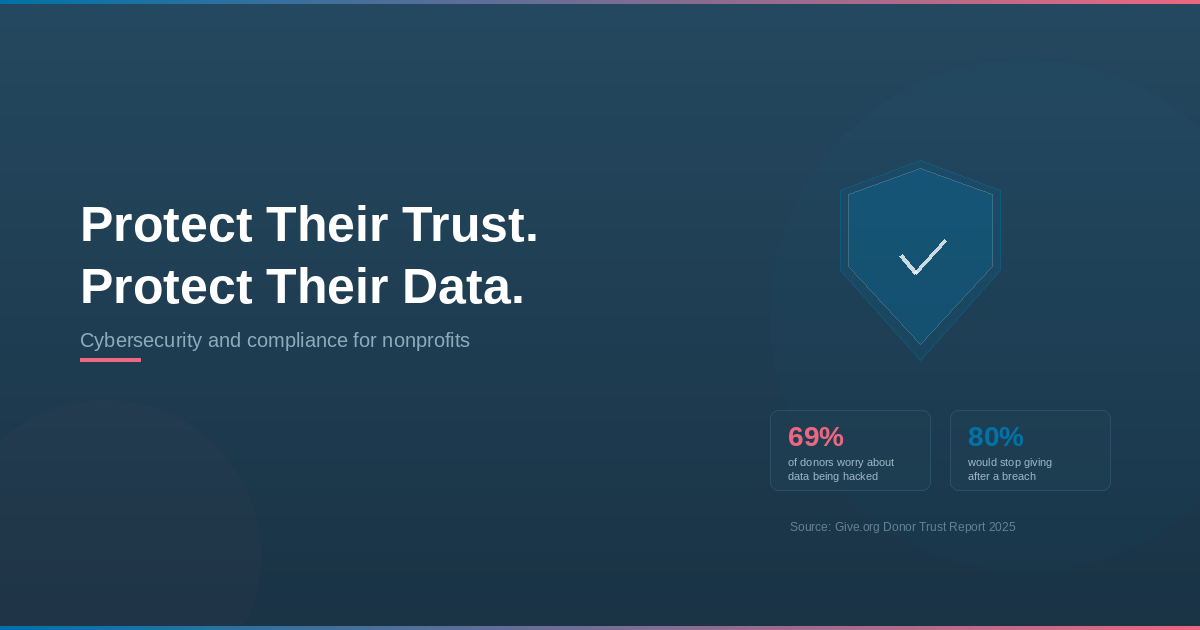
Donors care about data security. A lot. The 2025 Give.org Donor Trust Report found that 69% of donors are concerned about their data being hacked or stolen when giving to a charity for the first time. Even more telling, 80% of donors said they would stop giving or hold off on donations to an organization that experienced a data breach.
Data protection also ranked as the third most important factor donors consider when evaluating a nonprofit’s accountability, right behind how money is spent and whether fundraising appeals are honest.
In short, if donors do not trust you to protect their information, they will not give. And if they hear about a breach, many will walk away.
The Cybersecurity Risks Nonprofits Face
Understanding the risks is the first step to addressing them. Here are the most common threats nonprofits deal with.
Phishing and Social Engineering
Phishing is when someone sends a fake email or message designed to trick a staff member into clicking a dangerous link, opening an infected attachment, or sharing sensitive login information. It is the most common entry point for cyberattacks across all sectors.
According to BDO’s 2025 cybersecurity report, 68% of breaches involved a human element, such as phishing or human error. That means most breaches do not happen because hackers outsmarted a firewall. They happen because someone on the team made an honest mistake.
Ransomware
Ransomware is a type of attack where criminals lock your files and demand payment to unlock them. The average ransomware demand increased by nearly $1 million in 2024 compared to the previous year, according to BDO’s analysis. For a nonprofit operating on a tight budget, this kind of attack can be devastating.
Weak Security Practices
Many nonprofits unintentionally leave the door open to attackers. A study by Tardigrade Technology found that 71% of nonprofits allow staff to use unsecured personal devices to access organizational emails and files, and 9 out of 10 nonprofits do not train staff regularly on cybersecurity.
These are not exotic, high-tech vulnerabilities. They are basic gaps that are relatively straightforward to fix.
Understanding the Rules: Data Privacy Regulations That Apply to Nonprofits
Beyond the practical security risks, there are legal requirements around how you collect, store, and use donor data. The specific rules depend on where your nonprofit operates and where your donors are located.
PIPEDA (Canada)
If your nonprofit is based in Canada, PIPEDA (the Personal Information Protection and Electronic Documents Act) is the key federal privacy law to know about. A common misconception is that nonprofits are automatically exempt. They are not.
PIPEDA applies to any organization engaged in “commercial activity,” and that definition is based on the activity itself, not on your tax status. For example, if your nonprofit rents or purchases donor lists for acquisition campaigns, that is considered commercial activity under PIPEDA, and you must comply. Day-to-day communications with existing donors, such as thank-you emails and newsletters, are generally exempt. But acquisition campaigns using third-party data are not.
In Quebec, the rules are even stricter. Quebec’s privacy law does not provide an exemption for nonprofits, so if you operate there or have donors in Quebec, you need to be especially careful.
It is also worth noting that Canada’s proposed Consumer Privacy Protection Act (part of Bill C-27) could significantly increase penalties for non-compliance, potentially up to $25 million CAD or 5% of global revenue.
GDPR (European Union)
If any of your donors are in the European Union, the GDPR (General Data Protection Regulation) applies to you, regardless of where your nonprofit is based. This means if someone in Europe donates through your website, you need to handle their data according to GDPR standards, including clear consent, the right to access their data, and the right to have it deleted.
GDPR fines can be severe: up to 20 million euros or 4% of global annual revenue, whichever is higher.
CCPA (California, USA)
The CCPA (California Consumer Privacy Act) gives California residents the right to know what personal data is being collected about them, to request deletion of their data, and to opt out of data sales. If your nonprofit collects information from California-based donors, you should be aware of these requirements.
The Practical Takeaway
You do not need to become a legal expert. But you do need to know that data privacy is regulated, that the rules vary by location, and that your nonprofit is likely covered by at least one of these frameworks. If you are unsure, it is worth consulting with a privacy professional who understands the nonprofit sector.
7 Steps to Protect Your Donor Data
Here are practical, actionable steps any nonprofit can take to improve its cybersecurity posture, regardless of budget or team size.
1. Train your team regularly
Since most breaches are caused by human error, training is your most important defense. Teach your staff and regular volunteers how to spot phishing emails, use strong passwords, and handle sensitive data responsibly.
Training does not have to be expensive. NTEN (the Nonprofit Technology Enterprise Network) offers a free, fully funded Nonprofit Cybersecurity Readiness program, a three-month learning program designed to help nonprofit staff assess risks and build security plans. They also recommend free tools like KnowBe4, which lets you run simulated phishing tests to see how your team responds.
The key is consistency. A one-time training session is not enough. Make cybersecurity awareness part of your ongoing culture.
2. Turn on multi-factor authentication (MFA)
Multi-factor authentication adds an extra step when logging in. Instead of just a password, you also need a second form of verification, like a code sent to your phone. This single step dramatically reduces the risk of unauthorized access, even if someone’s password is stolen.
Turn on MFA for your email accounts, your CRM, your donation platform, and any other system that stores donor information. Most modern platforms support it, and it takes just a few minutes to set up.
3. Keep your software updated
Outdated software is one of the easiest things for attackers to exploit. When your operating system, your CRM, or your email platform releases an update, it often includes security patches that fix known vulnerabilities.
Set your systems to update automatically when possible. If your nonprofit uses a cloud-based CRM like GiveLife365, which runs on the Microsoft Power platform, security updates are handled by the platform provider, so you benefit from enterprise-level security without having to manage it yourself.
4. Use encryption and strong access controls
Encryption scrambles data so that even if someone intercepts it, they cannot read it without the right key. Make sure your donor data is encrypted both “at rest” (when stored) and “in transit” (when being sent, such as during an online donation).
Access controls determine who on your team can see what. Not everyone in your organization needs access to every piece of donor information. Limit access based on roles. For example, a volunteer coordinator might need to see volunteer schedules but does not need access to donor payment details.
5. Have a plan for when things go wrong
No security system is perfect. Having an incident response plan means your team knows exactly what to do if a breach happens: who to notify, how to contain the damage, and how to communicate with affected donors.
According to IBM’s 2025 Cost of a Data Breach Report, the average time to identify and contain a breach is 241 days. Organizations with a clear response plan in place significantly reduce both the time to recovery and the total cost.
6. Vet your technology vendors
Your donor management software handles some of your most sensitive data. When choosing a platform, ask vendors about their security practices. Do they encrypt data? Do they comply with relevant privacy regulations? Do they conduct regular security audits? Are they hosted on a trusted, enterprise-grade cloud platform?
GiveLife365, for example, is built on Microsoft Power platform, which benefits from Microsoft’s extensive security infrastructure, including data encryption, role-based access controls, regular security updates, and compliance with major data protection frameworks. Choosing a CRM with this kind of built-in security means your nonprofit does not have to build those protections from scratch.
7. Review and audit regularly
Cybersecurity is not a set-it-and-forget-it task. Conduct periodic reviews of your security practices. Check who has access to what. Test your team’s phishing awareness. Review your privacy policy to make sure it reflects your current data practices. BDO recommends making cybersecurity a board-level priority, with regular updates and accountability.
Building Donor Trust Through Transparency
Protecting donor data is not just about avoiding problems. It is also an opportunity to strengthen trust. When donors know you take their privacy seriously, it reinforces their decision to support you.
A few ways to demonstrate your commitment:
– Include a clear, easy-to-read privacy policy on your website that explains what data you collect, how you use it, and how donors can request changes.
– Use secure donation pages with SSL certificates and trusted payment processors.
– Let donors opt in to communications rather than adding them automatically.
– If a security incident does occur, communicate openly and quickly about what happened and what you are doing to fix it.
In an era where data breaches regularly make headlines, a nonprofit that visibly prioritizes donor privacy stands out for all the right reasons.
Protecting Data Is Protecting Your Mission
Every dollar your nonprofit raises depends on the trust of the people who give it. Cybersecurity and compliance might not be the most exciting topics, but they are among the most important ones for any organization that handles donor information.
The good news is that most of the highest-impact security steps are also the most accessible: training your team, turning on multi-factor authentication, keeping software updated, and choosing a secure CRM. You do not need a massive IT budget to make meaningful progress.
Start with one or two steps from this guide and build from there. Your donors’ trust is worth the investment.
Ready to see how a secure, nonprofit-focused CRM can simplify your data management? Book a free demo of GiveLife365 and discover how the right tools can help you protect donor data while growing your impact.
