


Picture this: Sarah donates $50 to a local animal shelter. She feels good about it, but by the next morning she has moved on. Then, two days later, she gets a warm thank-you email with a photo of the dogs her gift helped feed. A month later, she receives a short update showing how the shelter’s program is growing. Three months in, she is invited to volunteer at an adoption event. A year later, she signs up as a monthly donor. Two years on, she is telling her friends about the shelter and helping plan their annual fundraiser.
Sarah’s story is not a lucky accident. It is what happens when a nonprofit is intentional about its donor relationships, using the right mix of appreciation, communication, and follow-through to turn a one-time gift into a lifelong partnership.
This guide will walk you through how to build that kind of donor journey, step by step, with practical strategies backed by current research.
Why the Donor Journey Matters More Than Ever
The nonprofit sector is facing a persistent donor retention challenge. According to the Fundraising Effectiveness Project Q3 2025 report, the average donor retention rate sits at just 31.9%, and only 14% of first-time donors return to give again.
That means for every 100 new donors your nonprofit brings in, roughly 86 of them will not make a second gift. That is a lot of lost potential, not just in dollars, but in relationships, advocacy, and long-term community support.
But here is the encouraging part: once a donor makes a second gift, everything changes. Research from the Fundraising Effectiveness Project shows that 59% of donors who give a second time continue giving long-term. And donors with seven or more gifts retain at 87.3%. The goal is not just to get a gift. It is to build a relationship that deepens over time.
That is what the donor journey is all about. It is a framework for thinking about each donor as a person on a path, from their first moment of awareness all the way to becoming a loyal advocate for your cause.
The Stages of the Donor Journey
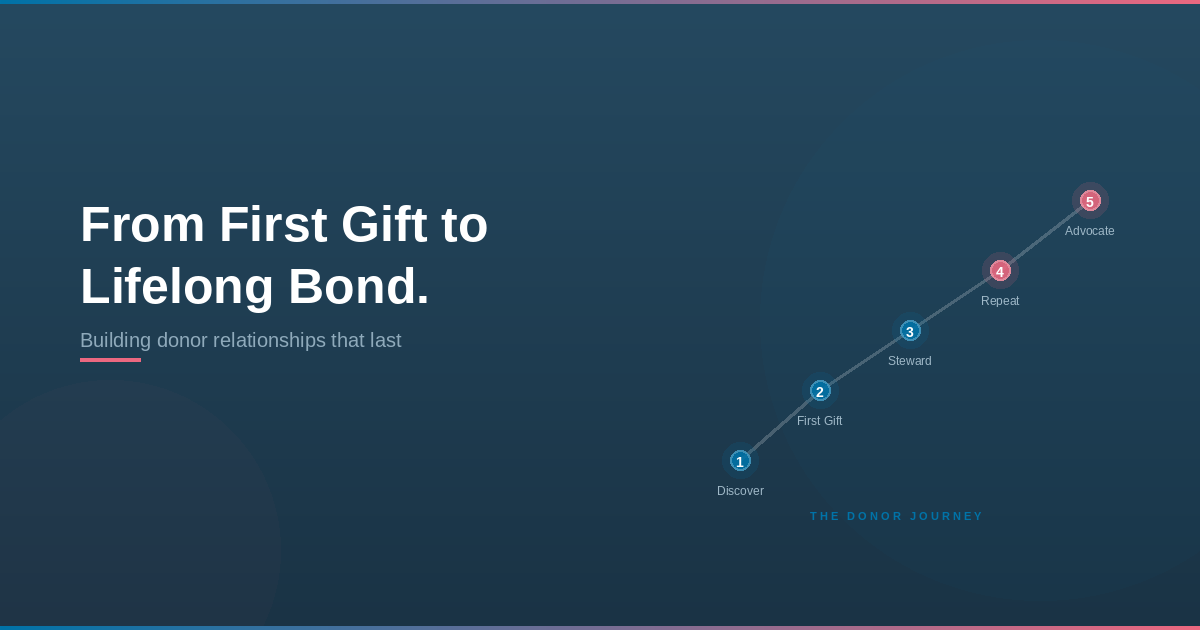
Every donor relationship moves through a series of natural stages. Understanding these stages helps you meet supporters where they are and give them what they need at each point.
Stage 1: Discovery
This is the moment someone first learns about your nonprofit. Maybe they see a social media post, hear about you from a friend, find your website through a search, or attend a community event. At this stage, they do not know much about you. Your job is to make a strong first impression by clearly communicating who you are, what you do, and why it matters.
Stage 2: First Gift
The first donation is a big moment. The donor has moved from awareness to action. They have said, “I believe in this enough to give my money.” What happens next is critical. According to Nonprofit Tech for Good, 33% of online donors say that email is the communication method most likely to inspire them to give again. But inspiration does not happen if you go silent after the first gift.
Stage 3: Stewardship and Deepening
This is the stage where most nonprofits either win or lose the relationship. Stewardship is about making the donor feel valued, showing them the impact of their gift, and keeping them connected to your mission. Research points to a 90-day window after each gift as the peak engagement period. What you do during those 90 days largely determines whether a donor comes back.
Stage 4: Repeat Giving and Growth
As donors continue giving, their connection to your organization deepens. This is when you might invite them to become a monthly donor, attend an event, volunteer, or increase their gift. Monthly giving is one of the most powerful loyalty drivers in nonprofit fundraising. The 2025 M+R Benchmarks Study found that monthly giving revenue grew 5% in 2024 and now accounts for 31% of all online nonprofit revenue. The average recurring donor stays with an organization for more than eight years, according to the 2025 Recurring Giving Benchmark Study.
Stage 5: Advocacy and Legacy
The final stage is when donors become true champions of your cause. They are not just giving money. They are spreading the word, recruiting new supporters, serving on boards, or even including your nonprofit in their estate plans. These are the relationships that sustain organizations for decades.
10 Strategies to Move Donors From First Gift to Lifelong Bond
Here are the practical steps that turn the donor journey from a nice idea into real results.
1. Thank donors quickly and personally
This is the foundation of everything. Send a heartfelt thank-you within 48 hours of every gift. Go beyond a generic receipt. Use the donor’s name, reference the amount they gave, and tell them specifically what their gift will help accomplish.
Even better, go beyond email. Candid’s donor stewardship guidance highlights that simple, meaningful touchpoints like a phone call, a handwritten note, or a short personal video can make a lasting impression and significantly strengthen loyalty.
Research shows that welcome emails have an average open rate of 80%, compared to about 28.59% for regular nonprofit emails. That first message after a gift is your best-performing communication. Make it count.
2. Show the impact of every gift
Donors do not want to feel like their money disappeared into a void. They want to know what happened because of their generosity.
Send a brief impact update within 30 days of the gift. It does not need to be a glossy annual report. A short email that says, “Because of supporters like you, we served 43 families last month” is powerful in its simplicity. Pair it with a photo or a short story from someone your programs helped.
Candid’s guidance on meaningful donor engagement emphasizes that both data and stories matter: data provides credibility, while stories create the emotional connection that keeps donors engaged. The most effective impact communication uses both together.
3. Personalize your outreach
Donors want to feel like individuals, not names on a mass mailing list. Personalized email subject lines are 26% more likely to be opened, and personalized calls to action convert 202% better than generic ones, according to Nonprofit Tech for Good.
Personalization goes beyond inserting a first name. It means referencing a donor’s past giving, sending them updates about the programs they care about most, and adjusting your communication frequency to match their preferences. A CRM makes this practical even for small teams, because it stores all the donor information you need in one place.
4. Segment your donors for smarter communication
Not every donor should get the same message. A first-time giver needs a different communication than a monthly supporter. A corporate sponsor needs different information than a retiree who volunteers on weekends.
Segmentation means grouping your donors based on things like gift size, giving frequency, interests, or how they first connected with you. Then you tailor your messaging to each group.
For example, you might send matching gift reminders to corporate donors, volunteer invitations to hands-on supporters, and upgrade asks to longtime monthly givers. Research shows that this kind of personalized approach can boost donations by as much as 25%.
5. Make recurring giving easy and appealing
Monthly giving is one of the best things you can do for your nonprofit’s financial stability, and it is also one of the strongest indicators of donor loyalty. The average recurring donor sticks around for more than eight years, compared to just 1.68 years for one-time donors.
Yet the 2025 M+R Benchmarks Study found that 64% of nonprofits still default their donation pages to one-time gifts. That is a missed opportunity.
Make monthly giving a prominent option on your donation page. Keep the sign-up process to just a few clicks. And once someone becomes a monthly donor, send them regular progress updates so they can see the ongoing impact of their commitment. Something like, “Your $25/month helped us provide clean water to 12 families this quarter” goes a long way.
6. Invite donors deeper into your mission
Giving money is just one way people support a cause. The strongest donor relationships develop when supporters have multiple ways to engage.
Invite loyal donors to volunteer at events. Offer them a spot on an advisory committee. Give them behind-the-scenes access to your programs. According to the 2025 M+R Benchmarks Study, direct service volunteers increased by 6% and advocacy volunteers grew by 11% in 2024. When donors also volunteer, they develop a much deeper connection to your mission.
Candid’s donor engagement research encourages nonprofits to position donors as thought partners, inviting their input and building genuine two-way relationships rather than one-sided asks.
7. Ask for feedback and act on it
One of the simplest and most underused donor engagement strategies is asking supporters what they think. Embed a short survey in a thank-you email. Ask what causes matter most to them. Invite their ideas for how your nonprofit could improve.
But here is the important part: follow up. Research has shown that surveying donors without acting on their feedback can actually harm the relationship. When you close the loop by sharing how their input shaped a decision, donors feel heard and valued.
8. Celebrate milestones and show appreciation
People remember how you make them feel. Automated recognition for donor milestones (like “Thank you for 3 years of support!” or “You just passed $1,000 in total giving!”) costs almost nothing but builds real loyalty.
You can send milestone acknowledgments through email, social media shoutouts, or even a handwritten note. The key is consistency. Every donor should feel appreciated, not just your biggest givers.
9. Watch for signs of disengagement
Donor retention is not just about keeping happy supporters happy. It is also about catching donors who are starting to drift away before they are gone.
The Fundraising Effectiveness Project data shows that micro donors ($1 to $100) have the lowest retention rate at 21.3%, while major donors ($5,000 to $50,000) retain at nearly 43%. If a regular donor skips a gift or stops opening your emails, that is a signal to reach out. A personal “We miss you” email, a phone call, or an exclusive update can re-engage a donor who might otherwise lapse.
10. Create pathways for growth
The donor journey should always have a next step. After someone gives a one-time gift, suggest monthly giving. After six months of monthly giving, invite them to consider increasing their amount. For long-term supporters, share information about legacy giving or planned gifts.
These “nudges” work best when they are based on real data about each donor’s history and behavior, and when they feel like a natural part of the relationship, not a sales pitch.
How a CRM Brings the Donor Journey Together
Every one of these strategies is more effective and more manageable with the right technology behind it. A CRM built for nonprofits acts as the central nervous system of your donor relationships, connecting data, communication, and action in one place.
Here is what a good nonprofit CRM helps you do:
– Keep a detailed profile of every donor: giving history, preferences, interactions, and milestones
– Automate thank-yous, impact updates, and milestone recognitions so nothing falls through the cracks
– Segment donors into meaningful groups for targeted outreach
– Track recurring giving and manage subscriptions with ease
– Monitor retention risks by flagging donors who show signs of disengagement
– Sync donor data with your volunteer management, event planning, and campaign tools
– Generate impact reports that turn your program data into compelling stories for donors
GiveLife365 is a nonprofit CRM designed to do exactly this. Built on the Microsoft Power platform, it brings donor management, volunteer coordination, event management, membership tracking, case management, and impact reporting into a single, easy-to-use system. Instead of toggling between spreadsheets, email platforms, and disconnected tools, your team can manage the entire donor journey from one dashboard.
The result? Less time on admin, more time on relationships. And relationships are what turn first-time givers into lifelong supporters.
Every Donor Has a Journey
The difference between a one-time gift and a lifelong partnership comes down to what happens after the donation. Nonprofits that thank quickly, show impact clearly, communicate personally, and offer meaningful ways to stay involved are the ones that build communities of loyal supporters.
You do not need to do everything at once. Start with one or two strategies, like speeding up your thank-you process or sending a monthly impact update, and build from there.
Remember Sarah? She did not become a lifelong advocate because the animal shelter was lucky. She stayed because at every step, they made her feel valued, informed, and connected to the difference her support was making.
That is the donor journey. And with the right approach and tools, it is one your nonprofit can create for every supporter.
Ready to build lasting donor relationships? Book a free demo of GiveLife365 and see how the right CRM can help your nonprofit turn first-time gifts into lifelong bonds.
