


Every nonprofit has stories worth telling. The family that found housing through your program. The student who earned a scholarship because donors believed in her potential. The community garden that transformed a vacant lot into a gathering place. These moments are the heart of your mission. And when you share them well, they become one of the most powerful tools you have to engage donors, recruit volunteers, and grow your impact.
This is not about flashy marketing or expensive video production. It is about learning to communicate your work in a way that connects with people on a human level, because that connection is what turns a casual supporter into a lifelong champion.
This guide will walk you through why storytelling matters so much for nonprofits, what the research says about its impact, and how to put practical storytelling strategies to work for your organization.
Why Storytelling Works: The Science and the Numbers
There is a reason stories stick with us long after facts and figures fade. According to research from the Stanford Graduate School of Business, stories are remembered up to 22 times more than facts alone. When we hear a compelling narrative, our brains release oxytocin, the chemical associated with empathy and connection, which makes us more likely to take action.
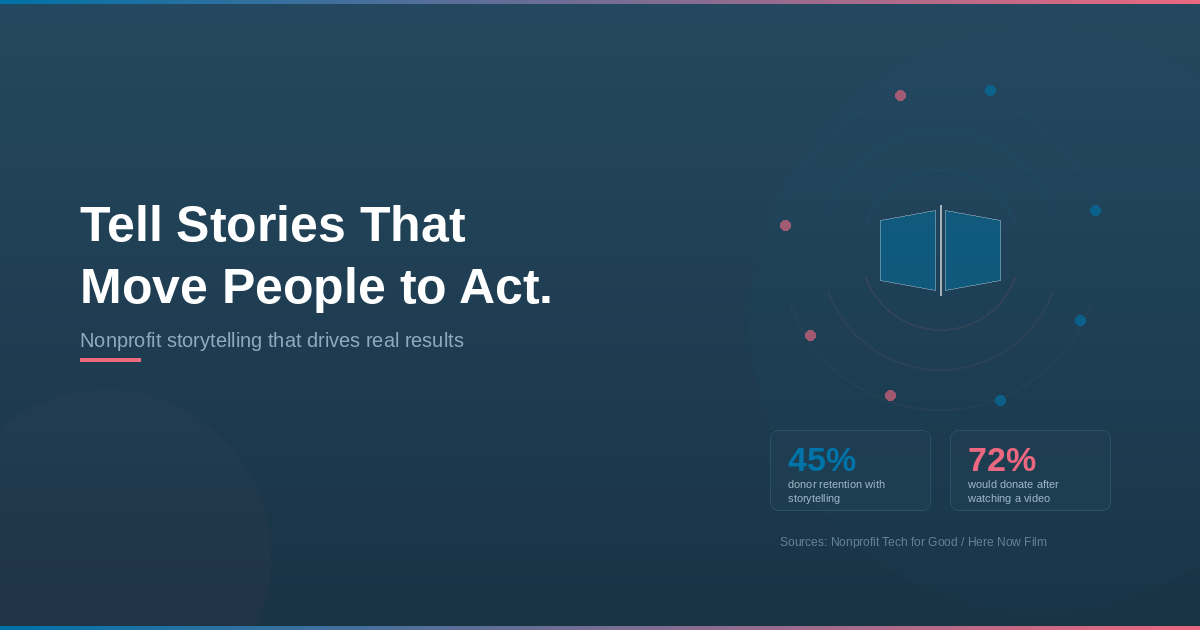
For nonprofits, this is not just interesting science. It translates directly into real results. Nonprofits that effectively use storytelling in their fundraising efforts have a donor retention rate of 45%, compared to just 27% for organizations that do not prioritize storytelling. In a sector where the average donor retention rate sits at just 31.9%, that difference is enormous.
Storytelling also drives giving. Research published by the Stanford Social Innovation Review found that nonprofits that tell engaging stories raise twice as much money on average as those that do not. And according to Nonprofit Tech for Good, 33% of donors say email is the tool that most inspires them to give, with the most effective emails being the ones that tell a story rather than simply ask for money.
In short, your stories are not a nice extra. They are a fundraising and engagement strategy.
The Building Blocks of Great Nonprofit Stories
Before diving into specific tactics, it helps to understand what makes a nonprofit story effective. The best stories share a few key ingredients.
Start with a real person
The most compelling nonprofit stories center on a specific individual, not a program description or a list of statistics. Instead of saying “We served 500 families last year,” tell the story of one family. Give them a name (with permission), describe their challenge, and show how your organization helped them move forward.
Candid’s guidance on donor engagement emphasizes that both data and personal stories matter: data provides credibility, while stories create the emotional connection that keeps donors engaged.
Show the transformation
Every strong story has a beginning, middle, and end. For nonprofits, the most powerful structure follows a simple arc: Here is the challenge someone faced. Here is how your support made a difference. Here is where they are now. This “before, during, and after” framework gives donors a clear picture of the change their generosity creates.
Keep it simple and honest
You do not need a professional writer to tell a great story. In fact, the most effective stories are often the simplest ones. Speak in plain language. Avoid jargon. Be honest about the challenges your organization faces as well as the successes. Donors can sense authenticity, and they value it.
5 Storytelling Strategies That Drive Results
Here are five practical approaches any nonprofit can use to strengthen its storytelling, regardless of budget or team size.
1. Use video to multiply your impact
Video has become the single most powerful storytelling medium for nonprofits. The numbers make it clear: 72% of donors say they are “very likely” to donate after watching a video about a nonprofit’s work, and donors are 48% more likely to give after watching a fundraising video. Using emotional storytelling in videos can increase donations by 38%.
And here is a number worth remembering: people retain 95% of a message when they watch it in a video, compared to just 10% when reading it as text. For nonprofits, that means a well-crafted video has enormous potential to educate audiences and move them to action.
The good news is that you do not need a big production budget. Short, authentic videos filmed on a smartphone can be just as effective as polished productions. In fact, audiences today often respond better to content that feels real and spontaneous rather than overly produced. Short-form videos under two minutes receive 60% higher completion rates than longer content.
A few practical ideas for nonprofit video storytelling:
– Record a 60-second “thank you” video from a program participant and share it with donors.
– Film a short behind-the-scenes look at your team in action.
– Create a brief “impact update” video each month showing what donor support made possible.
– Go live on social media during an event or milestone moment. Live videos generate 7 times more engagement than pre-recorded content.
The key is consistency. Even one short video a month can make a meaningful difference in how connected your donors feel to your mission.
2. Personalize your stories for different audiences
Not every donor needs to hear the same story. A first-time giver might need to hear about the basics of your mission, while a long-time supporter might be more interested in a deeper look at your latest program outcomes.
Personalization makes a real difference. Emails with personalized subject lines are 26% more likely to be opened, and personalized calls to action convert 202% better than generic ones. One nonprofit, Lifehouse, achieved a 27% increase in year-end donations after implementing a data-driven approach with personalized messaging tailored to different donor segments.
What does personalized storytelling look like in practice?
– Segment your donor list by giving history, interests, or how they first connected with you.
– Send program-specific updates to donors who gave to specific campaigns.
– Reference a donor’s past contributions when sharing impact stories (“Because of supporters like you who gave during our spring campaign, Maria was able to complete her training program”).
– Use your CRM to track which stories and topics each donor engages with most, and send more of what resonates.
Of nonprofit leaders whose organizations create donor engagement strategies, 64% employ storytelling as a core tactic, alongside digital communications, events, and impact reporting.
3. Combine data with emotion
The most effective nonprofit communications use both numbers and narratives together. Data gives your story credibility. A personal story gives it heart. When you pair them, you create something donors find both convincing and moving.
For example, instead of just saying “Hunger is a growing problem in our community,” try: “Last year, food insecurity in our county rose by 18%. For families like the Garcias, that meant choosing between paying rent and putting dinner on the table. Thanks to donors like you, our food bank served the Garcia family and 2,300 others, delivering over 45,000 meals in 2025.”
Emails that weave storytelling into their content have a 26% higher click-through rate than those without stories. The key is to use statistics as a supporting element, not the main event. Lead with the person, then bring in the numbers to show the bigger picture.
4. Meet supporters where they are on social media
Social media is one of the most accessible storytelling platforms available to nonprofits, and the data shows it works. According to Nonprofit Tech for Good, 93% of nonprofits use Facebook, nearly half maintain active LinkedIn pages, and 27% of nonprofits worldwide now use TikTok, which has an engagement rate of 7.5%, far higher than other platforms.
The type of content that performs best on social media is exactly the kind nonprofits are well positioned to create: human stories, emotional moments, and behind-the-scenes glimpses. Social media posts with compelling stories generate up to 10 times more engagement than posts without stories. Posts that center on a specific person, story, or transformation consistently outperform generalized organizational updates.
A few tips for social media storytelling:
– Share short supporter spotlights and beneficiary stories (with permission) regularly.
– Use carousels and short-form video to break longer stories into digestible pieces.
– Engage with comments and questions to build a sense of community.
– Repurpose one great story across multiple platforms in different formats.
You do not need to be on every platform. Pick the one or two where your supporters are most active and focus your energy there. A 2025 report found that 61% of Gen Z donors say creator involvement makes them more likely to donate, meaning younger supporters increasingly engage with causes through authentic, story-driven content rather than traditional appeals.
5. Build a storytelling culture across your organization
The best nonprofit storytelling does not come from the marketing department alone. It comes from everyone in your organization. Your program staff, volunteers, and board members all interact with people whose lives are changed by your work. They are sitting on a goldmine of stories.
Research consistently shows that 55% of people are more likely to volunteer for a nonprofit when they see direct impact communicated through stories. The more stories you collect and share, the more supporters you attract.
Here are a few ways to build a storytelling culture:
– Create a simple process for staff and volunteers to submit stories. It can be as easy as a shared form or a quick voice memo.
– Train your team to recognize “story moments” in their daily work, the small wins, the breakthroughs, the unexpected connections.
– Maintain a story bank in your CRM or a shared folder so you always have fresh material ready when you need it.
– Celebrate and share the stories your team collects, so everyone sees how their contributions make a difference.
When storytelling becomes part of your organizational DNA, you will never run out of compelling content to share.
How a CRM Powers Your Storytelling
Every one of these strategies works better when you have the right technology to support it. A nonprofit CRM helps you connect the dots between your stories and your supporters.
Here is what a good CRM makes possible:
– Store donor preferences and engagement history so you know which stories resonate with which supporters.
– Segment your audience for personalized storytelling and targeted outreach.
– Track the impact of your programs so you have real data to pair with your narratives.
– Automate follow-up communications, like thank-you emails and impact updates, so no donor falls through the cracks.
– Collect and organize stories from across your organization in one central place.
GiveLife365 is a nonprofit CRM built on the Microsoft Power platform that brings donor management, volunteer coordination, event management, membership tracking, case management, and impact reporting together in one system. When your storytelling is powered by real data and delivered to the right people at the right time, it stops being just communication. It becomes the engine that drives deeper relationships and more generous giving.
Your Stories Are Your Superpower
In a world where donors are bombarded with appeals from every direction, the nonprofits that stand out are the ones that tell human stories with clarity, honesty, and heart. You do not need a big budget or a fancy video team. You need a commitment to sharing the real impact of your work, consistently and authentically.
Start small. Tell one story this week. Send one thank-you video. Share one impact update with a real name and a real outcome. Then do it again next week.
The research is clear: storytelling does not just feel good. It drives retention, increases giving, and builds the kind of loyalty that sustains organizations for years to come.
Ready to turn your impact into stories that inspire? Book a free demo of GiveLife365 and discover how the right CRM can help your nonprofit collect, personalize, and share the stories that move supporters to action.
