


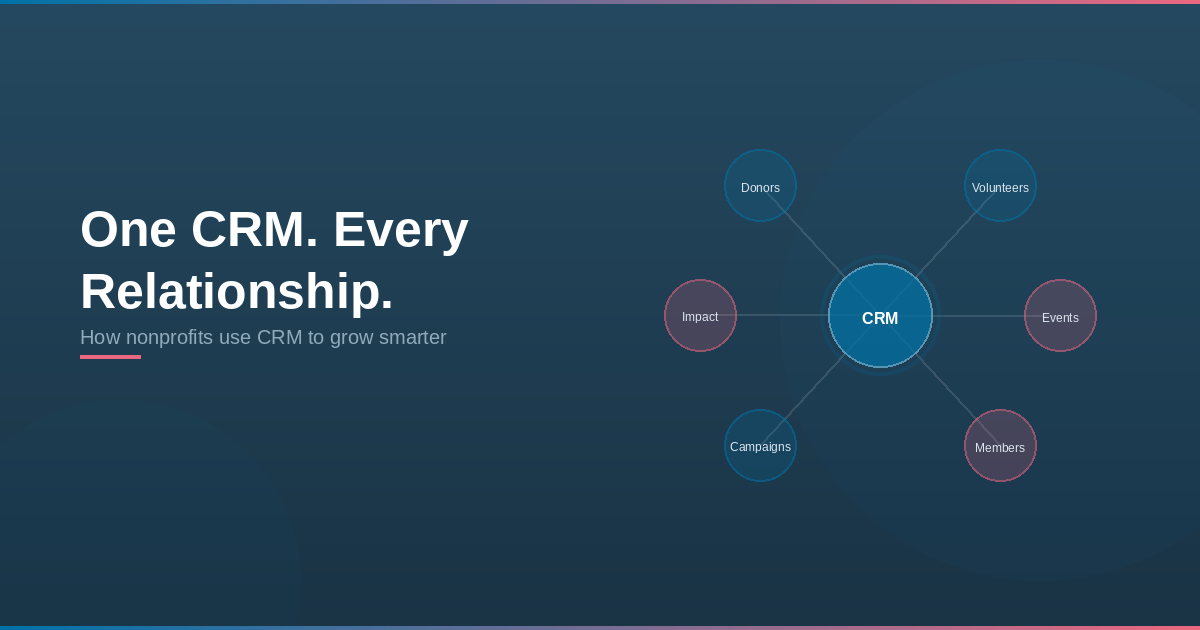
Running a nonprofit means wearing a lot of hats. You are managing donors, coordinating volunteers, planning events, keeping members engaged, and trying to grow your impact, often with a small team and a tight budget. At some point, spreadsheets and scattered tools just cannot keep up.
That is where a CRM comes in. CRM stands for Customer Relationship Management, but for nonprofits, think of it as your “Community Relationship Management” tool. It is a central place to organize your contacts, track donations, manage volunteers, and see how all your efforts connect. And as your nonprofit grows, a good CRM grows with you.
In this guide, we will look at the specific ways a CRM helps nonprofits work smarter, build stronger relationships, and scale their operations without burning out their team.
Why Nonprofits Need a CRM More Than Ever
The nonprofit world is more competitive and complex than it used to be. U.S. charitable giving reached $592.50 billion in 2024, according to the Giving USA 2025 report. That is great news for the sector overall. But here is the challenge: the total number of individual donors keeps declining.
Data from the Fundraising Effectiveness Project, a collaboration between the Association of Fundraising Professionals (AFP) and GivingTuesday, shows that the number of donors dropped by about 1.9% through mid-2025, with overall donor retention sitting at just 26.3%. That means roughly three out of four donors who give this year will not come back next year.
For nonprofits, this creates a clear need: you have to get better at building relationships with the supporters you already have, while also finding new ones. Trying to do that with disconnected tools and manual processes is tough. A CRM gives you the foundation to manage all of it from one place.
The nonprofit software market reflects this shift. It was valued at $4.74 billion in 2025 and is projected to nearly double to $9.48 billion by 2035, according to Global Growth Insights. More nonprofits are investing in technology because they see the direct impact it has on their ability to grow.
Build Stronger Donor Relationships and Increase Loyalty
Your donors are the lifeblood of your organization. But keeping them engaged takes more than sending a thank-you email once a year.
Here is a number that should get your attention: only 19% of first-time donors gave again in 2024, according to the Fundraising Effectiveness Project, as reported by NonProfit PRO. Compare that to a 69% retention rate for existing, repeat donors. The gap is huge. And closing it starts with how well you know and communicate with your supporters.
A CRM helps you keep detailed records of every donor: when they first gave, how much, how often, which campaigns they responded to, and what communication they prefer. Instead of treating every donor the same, you can personalize your outreach based on their history and interests. Research shows that personalized calls to action convert 202% better than generic ones, and emails with personalized subject lines are 26% more likely to be opened.
A CRM also helps you track every type of contribution, not just financial donations. Whether someone donates money, gives their time, or provides in-kind support like supplies or professional services, all of it gets recorded in one place. You can then tie those contributions to specific programs or campaigns, giving you a clear picture of where support is coming from and where you need to focus your efforts.
And when it comes to fundraising campaigns, a CRM lets you segment your donor list so you can reach the right people with the right message. Instead of sending the same appeal to everyone, you can tailor your ask based on giving history, interests, and engagement level. That kind of targeted outreach is what turns one-time givers into long-term supporters.
Manage Volunteers More Effectively and Keep Them Coming Back
Volunteers are not just free labor. They are people who believe in your cause strongly enough to give their time. And their skills, experience, and dedication can have a huge impact on your programs.
But keeping volunteers engaged is a real challenge. According to the National Council of Nonprofits, 62% of nonprofit CEOs say that recruiting enough volunteers is an ongoing issue. And even when you do recruit them, retention can be tricky. Volunteer preferences are shifting. In 2025, 57% of volunteer opportunities included a hybrid or virtual option, and volunteers increasingly prefer shorter, flexible commitments over long-term schedules.
A CRM helps you manage all of this. You can create a profile for each volunteer that includes their availability, skills, interests, how long they have been with you, and which events or programs they have participated in. When a new project or event comes up, you can quickly search your volunteer database to find the right people for the role instead of scrambling at the last minute.
You can also track volunteer hours, schedule shifts, manage changes, and keep a history of each person’s contributions. This is not just good for operations. It shows your volunteers that you value them. When people feel seen and appreciated, they are more likely to stick around.
The 2025 M+R Benchmarks Study found that direct service volunteers increased by 6% and advocacy volunteers grew by 11% in 2024. That is encouraging growth, but only organizations with good systems in place can take full advantage of it. A CRM makes sure no volunteer falls through the cracks.
Run Smarter, More Targeted Campaigns
Whether you are running a year-end fundraising push, a membership drive, or an awareness campaign, the results depend heavily on how well you plan, target, and measure your efforts.
A CRM takes the guesswork out of campaign management. Instead of blasting the same message to your entire contact list, you can build targeted segments based on real data. For example, you might create one list of lapsed donors who gave last year but not this year, another list of monthly givers, and a third list of volunteers who might also be potential donors. Each group gets a message that speaks directly to them.
This matters more than you might think. Research compiled by Nonprofit Tech for Good shows that 33% of donors say email is what most inspires them to give, and 86% of nonprofits are already using email marketing as a core channel. But the nonprofits that see the best results are the ones that personalize their outreach rather than sending one-size-fits-all messages.
A CRM also helps you coordinate across channels. Maybe your campaign involves an email series, social media posts, and a direct mail piece. With a CRM, you can plan all of these from one place, track which channels are driving the most responses, and adjust in real time. The 2025 M+R Benchmarks Study found that 80% of nonprofits now conduct A/B testing on their email and ad messaging, a sign that the sector is getting more serious about using data to improve results.
And perhaps most importantly, a CRM gives you real-time reporting on how your campaigns are performing. You can see open rates, click-through rates, donation conversions, and response rates as your campaign unfolds, not just after it is over. That means you can make adjustments while there is still time to improve outcomes.
Simplify Membership Management
If your nonprofit runs a membership program, you know how much work goes into managing it. Tracking who is a member, when their membership expires, what level they belong to, and whether they have renewed can quickly become a headache, especially as your membership base grows.
A CRM simplifies all of this. Each member gets a profile with their membership type, start date, renewal date, payment history, and any special options or documents they have attached. You can set up automatic reminders when a renewal is coming due, so members do not lapse simply because they forgot.
This is especially important because recurring giving is one of the fastest-growing areas in nonprofit fundraising. The 2025 M+R Benchmarks Study found that monthly giving revenue grew 5% in 2024 and now accounts for 31% of all online revenue. The average recurring donor stays with an organization for more than eight years, compared to just 1.68 years for one-time donors, according to the 2025 Recurring Giving Benchmark Study. That kind of long-term support is exactly what helps nonprofits plan ahead with confidence.
A CRM also integrates with payment gateways, so recurring membership payments happen automatically. No more chasing people for renewals or manually processing payments. You can even automate communications with your members, like welcome messages for new sign-ups, renewal confirmations, and updates about member benefits. This frees up your team to focus on providing value to your members instead of administrative tasks.
Make Better Decisions With Centralized Data
One of the biggest advantages of a CRM that often gets overlooked is how it changes the way you use data. When your donor records, volunteer information, campaign results, and membership data all live in one system, you can see patterns and connections that would be invisible if everything were spread across different tools.
For example, you might discover that volunteers who attend your events are three times more likely to become donors. Or that donors who receive a personal thank-you call within 48 hours are more likely to give again. These kinds of insights only emerge when your data is connected.
This matters because organizations that lack a strategy for connecting tools and managing data face serious risks, including a loss of trust in their own reporting. According to data from the TechSoup and Tapp Network survey, as reported by NonProfit PRO, only 24% of nonprofits have formal policies around data and AI use, even though the majority are already using these tools.
The Fundraising Effectiveness Project data also highlights why this matters: repeat donors account for over 60% of total fundraising dollars. If you cannot easily identify who your repeat donors are, what they respond to, and when they are at risk of lapsing, you are leaving significant revenue on the table.
A CRM gives you dashboards, reports, and analytics that make it easy to track the metrics that matter most to your organization. Whether you are preparing a board report, evaluating a campaign, or planning next year’s strategy, having reliable, centralized data saves time and leads to better decisions.
What to Look for in a Nonprofit CRM
Not all CRMs are built the same. When evaluating options for your nonprofit, here are a few things to keep in mind:
Look for a CRM that is designed specifically for nonprofits, not a generic business tool that has been adapted. Nonprofit-specific CRMs understand the unique workflows around donor management, volunteer coordination, event planning, membership tracking, and impact reporting.
The system should be easy to use. Your team members are not IT professionals, and a tool that requires weeks of training to learn will not get adopted. Look for a modern, intuitive interface that your staff and volunteers can pick up quickly.
Integration matters. Your CRM should work well with payment processors, email platforms, and other tools you already use. Cloud-based systems are particularly helpful because they let your team access information from anywhere, which is increasingly important as hybrid work and remote volunteering become the norm.
GiveLife365 is one example of a CRM built from the ground up for nonprofits. Powered by the Microsoft Power platform, it brings donor management, volunteer coordination, membership tracking, event management, case management, and impact reporting into a single system. It is designed to be straightforward to use, so your team can spend less time on admin work and more time on your mission.
Getting Started
You do not need to overhaul everything at once. Many nonprofits start by moving their donor data into a CRM and then gradually add volunteer management, membership tracking, and campaign tools as they get comfortable.
The key is to start. Every day you spend managing contacts in spreadsheets or toggling between disconnected systems is a day you could be building deeper relationships and growing your impact.
Ready to see what a nonprofit CRM can do for your organization? Book a free demo of GiveLife365 and discover how the right tools can help you scale up without burning out.
