


The way people give to nonprofits is fundamentally different from what it was even five years ago. Donors are younger, more digital, more values-driven, and more demanding of transparency than ever before. They give from their phones, discover causes on social media, expect personalized communication, and want to see exactly how their money makes a difference.
For nonprofits, this shift is not a crisis. It is a roadmap. When you understand how donor behavior is evolving and align your tools and strategies to meet those expectations, you build stronger relationships, raise more money, and create a foundation for long-term growth.
This guide walks you through the most important changes in donor behavior right now, backed by current data, and the practical steps your nonprofit can take to stay ahead.
The Big Picture: Giving Is Growing, but Changing Shape
Charitable giving in the United States reached $592.5 billion in 2024, a 4.2% increase when adjusted for inflation. That is encouraging news. But beneath the top-line numbers, the composition of who gives, how they give, and what they expect is shifting in important ways.
Corporate giving grew 9.1% in 2024, the fastest growth among all major giving sources, reaching a record $44.4 billion. Millennial giving surged 22% to an average of $1,616 per donor, putting millennials within striking distance of baby boomer giving at comparable life stages.
At the same time, donor retention remains a stubborn challenge. Only 19% of first-time donors returned to give again in 2024, and existing donors retained at 69%. The nonprofits that succeed in this environment will be the ones that understand what today’s donors actually want and use the right tools to deliver it.
How Donor Behavior Is Shifting: 5 Key Trends
1. Donors are going digital, especially on mobile
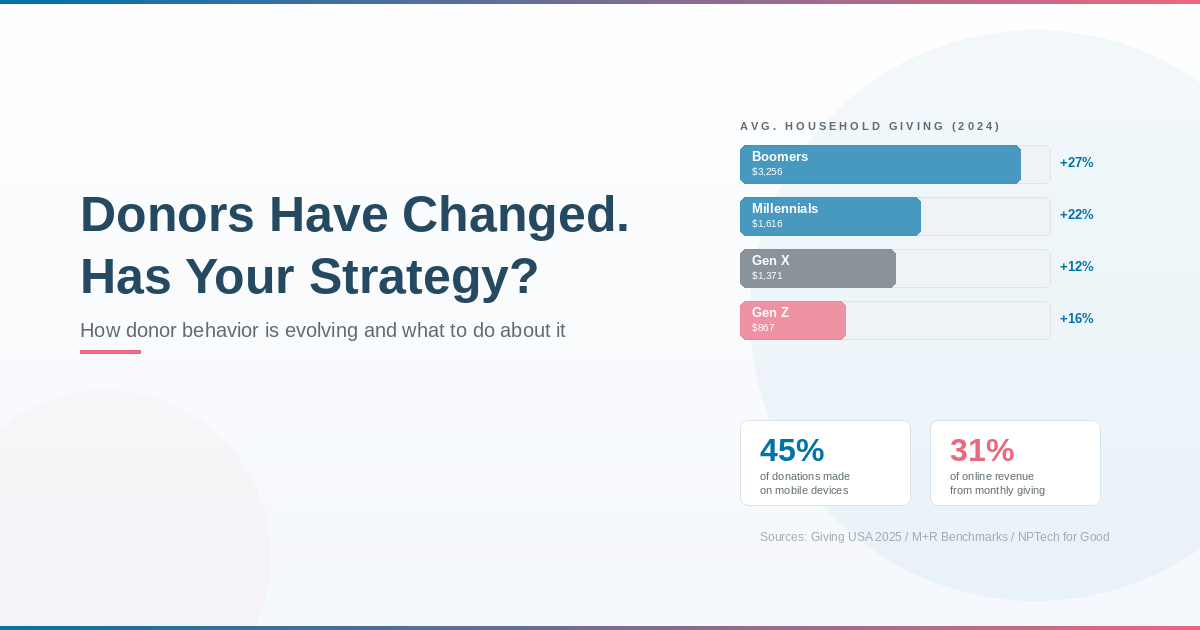
The shift to online giving has been building for years, and it is now firmly established. In 2024, 45% of all online donations were made on a mobile device, up from previous years. Desktop gifts still average more ($145 vs. $76 on mobile), but mobile volume is growing fast.
Donors also expect multiple ways to pay. The 2025 M+R Benchmarks Study found that 76% of nonprofits now accept PayPal, 47% accept Apple Pay, and 40% accept Google Pay. Reducing friction at the point of giving, whether that means accepting digital wallets, optimizing for mobile screens, or shortening donation forms, directly affects how many people complete their gifts.
Among younger generations, the trend is even more pronounced. A Candid analysis of Giving USA data found that 54% of millennials use smartphones to make donations, compared to 27% of baby boomers.
2. Each generation gives differently
Understanding generational differences is no longer optional for nonprofit fundraising teams. Each generation has distinct giving habits, communication preferences, and motivations.
According to the Giving USA “Giving by Generation” special report, average household giving in 2024 looked like this: baby boomers led at $3,256 (up 27% from 2021), followed by millennials at $1,616 (up 22%), Gen X at $1,371 (up 12%), and Gen Z at $867 (up 16%).
But the numbers only tell part of the story. Here is what differs across generations:
Communication frequency: 70% of Gen Z and 64% of millennials want monthly updates from the nonprofits they support, while baby boomers and Gen X prefer quarterly updates.
Giving style: More than half of both Gen Z and millennial donors prefer monthly giving arrangements, while older generations tend toward one-time or occasional gifts.
Discovery channels: Younger donors are far more likely to discover causes through social media and content creators. A 2025 report found that 61% of Gen Z donors say a creator’s involvement makes them more likely to donate.
Values alignment: Gen Z and millennial donors focus on supporting issues rather than specific organizations and see themselves as active social change agents.
The practical takeaway: a one-size-fits-all approach to donor communication no longer works. The more you can tailor your outreach to different donor segments, the stronger your results will be.
3. Personalization is no longer a bonus. It is expected.
Donors increasingly expect the same kind of personalized experience from nonprofits that they get from every other part of their digital lives. Generic mass emails and one-size-fits-all appeals are losing effectiveness.
According to Nonprofit Tech for Good, personalized email subject lines are 26% more likely to be opened, and personalized calls to action convert 202% better than generic ones. Emails with stories and personalized content see a 26% higher click-through rate than those without.
A survey of 641 online donors found that 57% believe nonprofits effectively communicate the impact of their donations, but 38% disagree. That 38% represents a significant group of supporters who feel left in the dark about what their gifts accomplished. Closing that gap with personalized impact updates is one of the highest-return investments a nonprofit can make.
The data also shows that personalization drives retention. A nonprofit called Lifehouse achieved a 27% increase in year-end donations by implementing a data-driven approach with donor tiering and personalized messaging for different segments.
4. Transparency and trust are top priorities
Donors care deeply about where their money goes. The Give.org Donor Trust Report found that the top three accountability priorities for donors are: how the charity spends its money, whether fundraising appeals are honest, and protection of donor information.
Nearly 69% of donors worry their information could be hacked when giving to a new charity, and 80% said they would stop or hold off on donations after learning about a data breach.
The flip side is encouraging: 93% of donors trust nonprofits and charities as ethical organizations. That trust is a powerful asset, but it needs to be actively maintained through honest communication, clear financial reporting, and visible impact updates.
Charity rating badges also matter. Nonprofit Tech for Good found that 72% of individuals say the presence of a charity rating badge increases their likelihood of giving.
5. Recurring giving is becoming the norm
Monthly giving has shifted from a nice option to a central pillar of nonprofit revenue. According to the 2025 M+R Benchmarks Study, monthly giving now accounts for 31% of all online nonprofit revenue and grew 5% in 2024, while one-time giving remained flat.
A survey by Nonprofit Tech for Good found that 44% of online donors are currently enrolled in monthly giving programs, and only 7% planned to cancel within three months. This is not just a trend among younger donors, though Gen Z and millennials are leading the way. It is becoming a preferred giving method across all demographics.
The financial case for recurring giving is compelling: the average monthly donor contributes about $288 per year, compared to $126 for the average one-time gift. And recurring donors stay far longer, with the average monthly donor remaining with an organization for more than eight years.
How Technology Helps You Adapt
Understanding these trends is the first step. Acting on them requires the right tools.
The nonprofit technology landscape has matured significantly. The nonprofit CRM software market is expected to nearly double from $282 million to $545 million by 2035, reflecting the growing recognition that technology is essential, not optional, for modern fundraising.
Here is how the right technology helps you respond to each of these donor behavior shifts:
For mobile and digital giving: A CRM integrated with your online donation platform ensures that every gift, whether made on a phone, through a digital wallet, or at an event, is captured and connected to the donor’s profile automatically.
For generational differences: Donor segmentation tools let you group supporters by age, giving history, communication preferences, and interests, so you can send the right message to the right person at the right time.
For personalization: With a complete view of each donor’s history and engagement in one place, your team can personalize thank-you messages, impact updates, and ask amounts without spending hours pulling data from different systems.
For transparency: Built-in reporting tools make it easy to generate impact reports, financial summaries, and program updates that demonstrate accountability to donors and funders.
For recurring giving: Automated recurring gift management tracks monthly donors, sends renewal reminders, and flags at-risk supporters before they lapse.
AI is also playing a growing role. The 2025 M+R Benchmarks Study found that 78% of nonprofits now use generative AI for marketing, fundraising, or advocacy. Practical applications include drafting donor communications, optimizing donation forms, and conducting donor research. AI-optimized donation forms average $161 per one-time gift compared to the $115 industry average.
How a CRM Makes It All Manageable
A nonprofit CRM is the technology foundation that ties all of these strategies together. It is the single system where your donor data, communication history, giving records, and program outcomes all connect.
Here is what a good nonprofit CRM helps you do:
– Capture donations from every channel, including online, mobile, event, and in-person, in one unified donor record.
– Segment donors by generation, giving history, interests, and engagement patterns for personalized outreach.
– Automate thank-you emails, impact updates, and recurring gift management so nothing falls through the cracks.
– Track donor retention and identify at-risk supporters before they lapse.
– Generate reports that demonstrate transparency and accountability to donors and funders.
– Manage events, volunteer programs, memberships, and cases alongside your fundraising data.
GiveLife365 is a nonprofit CRM built on the Microsoft Power platform that brings donor management, volunteer coordination, event management, membership tracking, case management, and impact reporting together in one system. Instead of cobbling together separate tools for email, events, donations, and reporting, your team gets a single dashboard that adapts to how today’s donors actually behave.
Meeting Donors Where They Are
Donor behavior will keep evolving. New platforms will emerge, new generations will enter the giving landscape, and expectations around transparency and personalization will continue to rise. The nonprofits that thrive will be the ones that stay curious about their supporters, invest in the right tools, and treat every interaction as an opportunity to build trust.
You do not need to overhaul everything at once. Start with the trend that matters most for your organization right now. Maybe that is optimizing your donation page for mobile. Maybe it is launching a monthly giving program. Maybe it is segmenting your donors so you can start personalizing your outreach.
Whatever you choose, the key is to let the data guide you and use technology to make it manageable.
Ready to meet your donors where they are? Book a free demo of GiveLife365 and see how a nonprofit CRM can help your team understand donor behavior, personalize engagement, and build the kind of relationships that last.
