


 8 minutes read
Here is a stat that might surprise you: 50% of members who do not renew cite budget concerns, lack of engagement, or low perceived value as their top reasons for leaving (The Nonprofit Times, 2026 Membership Performance Report). That means half of your membership losses come down to three fixable problems.
The reality is that running a membership program is one of the most effective ways to build recurring revenue, deepen supporter loyalty, and strengthen your nonprofit’s mission. But managing it well, with renewals, communications, onboarding, and engagement all running smoothly, takes more than a spreadsheet. It takes a purpose-built CRM.
This guide walks you through why membership matters, where most nonprofits struggle, and how the right CRM turns your membership program from a logistical headache into a growth engine.
Why Memberships Are Important for Nonprofits
Membership programs do something that one-time donations cannot. They create a predictable, recurring revenue stream that helps your nonprofit plan ahead with confidence. According to AFP Global, effective nonprofit membership programs offer an influx of recurring funds that can help organizations more easily plan for the future (AFP Global, “Membership Programs for Nonprofits: 6 Factors for Success”).
But the benefits go far beyond money. When someone becomes a member, they are making a statement. They are saying, “I believe in what you do, and I want to be part of it.” That sense of belonging transforms casual supporters into invested advocates who show up for fundraisers, speak on your behalf, and recruit others to join.
A well-designed membership program invites individuals to contribute something, usually money or time, to your organization. In return, members receive an ongoing affiliation with your nonprofit for a specific period. Membership often implies an “insider” status, giving people access to benefits, privileges, and opportunities that general supporters do not receive. Think exclusive events, early access to content, members-only updates, or voting rights in organizational decisions.
This sense of identity is powerful. When people feel connected to your mission, they stick around longer. According to the 2025 Bank of America Study of Philanthropy, 81% of affluent households made charitable contributions in 2024, and those with structured giving strategies, including memberships, gave an average of $33,219 (Bank of America, “2025 Study of Philanthropy”). Memberships create the kind of structured relationship that encourages giving at every level.
Membership programs also give your nonprofit a wider base of loyal supporters who will lend a hand with fundraising, public speaking, events, and other organizational tasks. That kind of distributed engagement is something money alone cannot buy.
The Real Challenges of Managing a Membership Program
Here is where things get tricky. Running a membership program sounds straightforward, but the day-to-day reality is anything but simple.
Keeping track of membership subscriptions, sending payment reminders, processing renewals, onboarding new members, offboarding lapsed ones, and segmenting your communications across different membership tiers are all tasks that pile up quickly. For nonprofits running complex membership programs with multiple levels and benefits, receiving immediate insights into member activity and enabling online renewals is not a luxury. It is a necessity.
And the data problem is real. Roughly three-quarters of nonprofit leaders cite challenges such as siloed data, resistance to change, and limited technical capacity as barriers to effective operations (NonProfit PRO, “Digital Transformation: What’s Holding Back Nonprofit Innovation?”). When your membership data lives in scattered spreadsheets, email threads, and someone’s memory, you cannot see what is happening with your program. You cannot spot members at risk of leaving. You cannot personalize your outreach. And you definitely cannot scale.
The 2026 Membership Performance Report found that only 43% of association and membership professionals can easily access and understand the data they need to track and improve performance (The Nonprofit Times). That means more than half are making decisions without clear information, and that is a recipe for attrition.
Why a CRM is the Solution for Membership Management
A CRM built for nonprofits changes the equation entirely. Instead of juggling disconnected tools, your entire membership program lives in one system: member profiles, subscription levels, payment histories, communication logs, event attendance, engagement patterns, and renewal timelines.
When you run a nonprofit, you are moving your mission forward with limited time and a tight budget. Implementing a well-built CRM helps you focus on increasing involvement and engagement from your supporters, rather than drowning in administrative tasks.
From programming customized messages for your membership tiers to automating onboarding sequences and membership renewal alerts, a good CRM keeps you ahead of the curve. It guards against membership attrition by doing the work that would otherwise fall through the cracks.
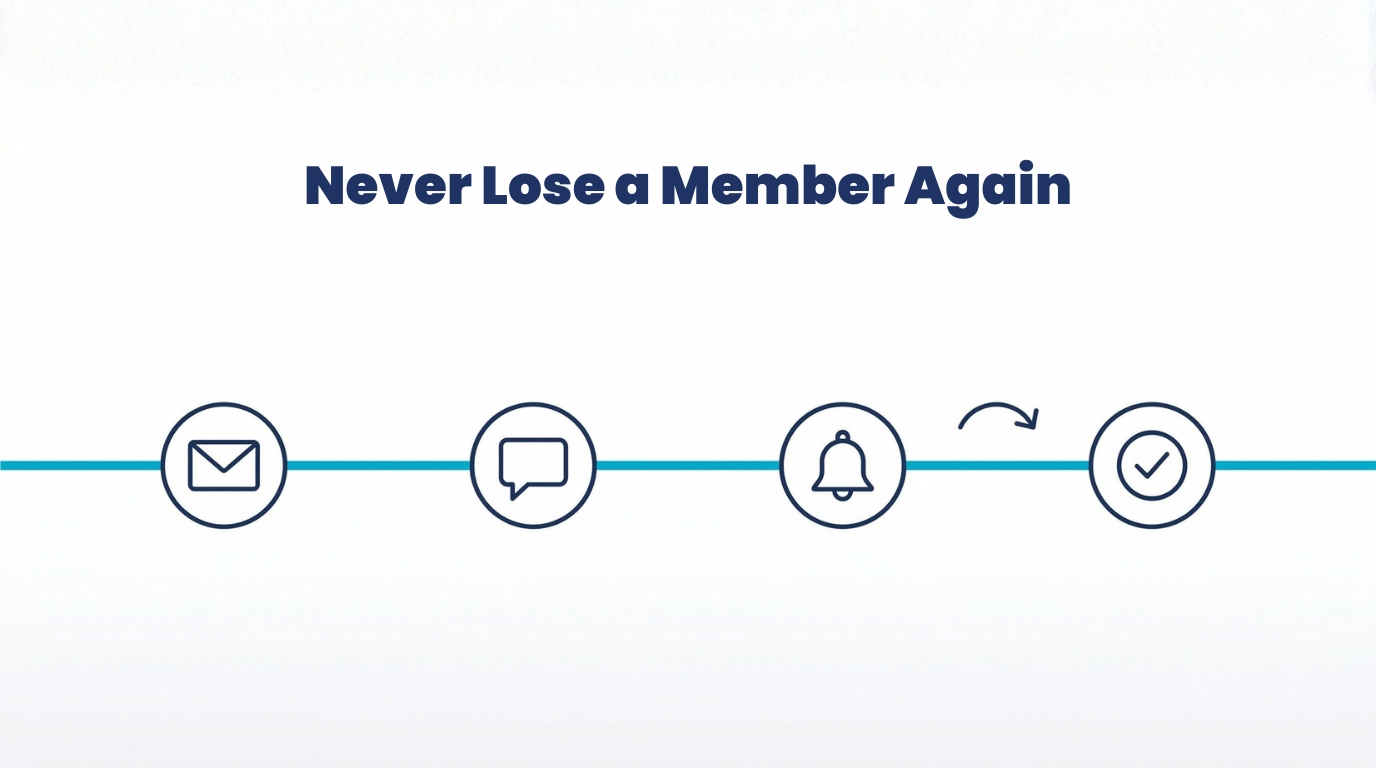
Here is what that looks like in practice. A new member signs up and immediately receives a welcome email with clear next steps. Three months in, they get a personalized check-in based on their engagement level. Six weeks before their membership expires, they receive a friendly renewal reminder. If they do not renew, a re-engagement sequence kicks in. All of this happens automatically, freeing your team to focus on building real relationships.
How to Build a Membership Program That Works
An effective membership management approach starts with clarity. Once you have established your organization’s mission and goals, you need to develop a membership program that aligns with your plans.
Start by listing the benefits you will provide to members at each level. Think about what makes membership valuable beyond the financial contribution. Exclusive content, networking opportunities, event access, recognition, voting rights, and early access to programs are all strong options. According to AFP Global, a successful membership program should include a clear plan with measurable goals, attractive benefits, a strong website, targeted marketing, and regular data collection (AFP Global, “Membership Programs for Nonprofits: 6 Factors for Success”).
Once you have mapped out your benefits, set membership fees that reflect the value members receive while remaining accessible to your audience. This forms the backbone of your membership management structure.
From there, focus on the member journey. What happens from the moment someone signs up through their first renewal? Every touchpoint matters. A strong onboarding experience sets the tone. Regular communication keeps members engaged. Timely renewal reminders prevent unnecessary lapses. And personal recognition makes people feel like they belong, not like they are just a line item in your database.
What to Look for in a Membership Management CRM
Not every CRM is designed with membership programs in mind. Here are the features that matter most for nonprofits managing members.
Centralized member profiles. Every interaction, from sign-up to donation history to event attendance, should be visible in one place. This gives your team a complete picture of each member without switching between systems.
Customizable membership tiers. Your CRM should let you create and manage multiple membership levels with different benefits, pricing, and durations. Members should be able to browse plans and subscribe to the one that fits them.
Automated renewals and reminders. Manual renewal follow-ups are a time drain and easy to miss. Your CRM should send automated reminders before memberships expire, process renewals, and flag lapsed members for re-engagement.
Self-service member portals. Give your members the ability to update their own profiles, view their membership status, access exclusive content, and manage their payment information. This reduces the administrative burden on your team and puts members in control of their experience.
Integrated communication tools. Whether it is email campaigns, newsletters, or targeted updates, your CRM should let you segment members by tier, engagement level, interests, and activity, so every message feels relevant.
Discount and promotion management. Being able to generate and offer discounts to specific member groups, run limited-time promotions, and incentivize upgrades or referrals helps your program grow.
Reporting and analytics. You need to see how your membership program is performing at a glance. Track renewal rates, new member acquisition, engagement trends, revenue by tier, and lapsed member patterns. The iMIS 2026 report showed that organizations with easy access to data reported higher retention and greater confidence in future growth (The Nonprofit Times).
Signs Your Nonprofit Needs a Membership Management CRM
Not sure if it is time to invest in a CRM? Here are some warning signs.
You are managing memberships across multiple spreadsheets or documents. Your team spends hours on manual data entry, renewal emails, and payment tracking. Lapsed members slip through the cracks because no one is monitoring expiration dates. You are sending the same generic messages to brand-new members and long-time supporters. You lack clear reports on how your membership program is performing. Members cannot access their own profiles or renew online. Your membership data is not connected to your donor, volunteer, or event data.
If any of these sound familiar, a CRM is not just nice to have. It is essential.
How GiveLife365 Makes Membership Management Simple
GiveLife365 is a nonprofit CRM built on Microsoft Power Apps that brings your entire membership program into one connected platform. Instead of patching together separate tools for memberships, donations, volunteers, events, and communications, everything works together in a single system.
Here is what GiveLife365 brings to your membership program:
Customizable membership tiers with flexible pricing and durations
Automated onboarding sequences for new members
Self-service member portals for profile updates and renewals
Automated renewal reminders and lapse notifications
Discount and promotion tools for member-exclusive offers
Integrated communication with Office 365 for personalized outreach
Real-time dashboards tracking renewal rates, engagement, and revenue
Connected data across donors, volunteers, events, and members
Secure, cloud-based access from any device.
Because GiveLife365 connects membership data with your donor management, volunteer management, and event management modules, you get a complete picture of every supporter’s relationship with your organization. A member who also donates and volunteers is not three separate records. They are one person with a rich history, and your team can engage them accordingly.
This means automating your membership management processes, maximizing retention, and providing your members with the experience they deserve, all while freeing your staff to focus on mission-critical work.
Growing Your Nonprofit Through Better Membership Management
When your membership program runs smoothly, growth follows naturally. Members who feel valued renew. Members who are engaged become advocates. Advocates bring in new members. And the cycle builds on itself.
With GiveLife365, you can grow your nonprofit by easily searching and managing your entire membership database from one place. You can customize membership levels and automate renewals so no one falls through the cracks. Real-time database updates save your team hours every week. Members can fill in their own details in their profile, keeping your data accurate without adding work. And everything is stored in a secure, cloud-based environment accessible from anywhere.
The bottom line is this: a membership program is one of the most powerful tools a nonprofit can have. But its potential is only as strong as the system behind it. When you pair a thoughtful membership strategy with a CRM designed for nonprofit needs, you stop losing members to preventable problems and start building a community that grows with your mission.
Want to see how it works? Book a Demo and discover how GiveLife365 can help you build a membership program your supporters love being part of.
FAQ
What is nonprofit membership management?
Nonprofit membership management is the process of organizing, tracking, and engaging the members who support your organization through a structured program. It covers everything from sign-up and onboarding to renewals, communications, and benefits delivery.
Why do nonprofits need a CRM for membership management?
A CRM centralizes all member data, automates renewals and communications, and gives your team clear reporting on how the program is performing. Without one, membership management relies on manual processes that are slow, error-prone, and difficult to scale.
What are the benefits of a nonprofit membership program?
Membership programs provide recurring revenue, deepen supporter engagement, create a sense of community, and give your nonprofit a base of loyal advocates. According to AFP Global, effective programs offer an influx of recurring funds that help organizations plan for the future.
How does GiveLife365 help with membership management?
GiveLife365 is a nonprofit CRM built on Microsoft Power Apps that manages memberships, donors, volunteers, and events in one platform. It offers customizable tiers, automated renewals, self-service portals, integrated communications, and real-time analytics.
What causes members to not renew their membership?
The 2026 Membership Performance Report found that the top three reasons for non-renewal are budget constraints, lack of engagement with the organization, and low perceived value. A CRM helps address all three by automating engagement, personalizing outreach, and demonstrating clear membership benefits.
Can members manage their own profiles in GiveLife365?
Yes. GiveLife365 provides self-service member portals where members can update their contact information, view their membership status, renew online, and access exclusive content without needing help from your team.
