


No one starts their Monday expecting a data breach, a funding freeze, or a public relations firestorm. But for nonprofits, crises are not hypothetical. They are statistical certainties. The only question is whether your organization will be ready when one arrives.
The stakes are high. Nonprofits operate with thin margins, deep community trust, and missions that people depend on. A single crisis, handled poorly, can undo years of relationship building. Handled well, it can actually strengthen your reputation and deepen donor confidence.
This guide walks through the most common crises nonprofits face today, backed by current data, and lays out a practical framework for building a crisis management plan that protects your mission, your people, and your supporters’ trust.
Why Crisis Preparedness Matters More Than Ever
The nonprofit sector is facing a convergence of pressures that make crisis preparedness essential, not optional.
A 2024/2025 survey by Grassi Advisors found that 81% of nonprofits reported higher operating costs, with the average increase reaching 15%. At the same time, 73% experienced increased demand for their programs and services. That combination of rising costs and rising demand creates an environment where even a moderate disruption can push an organization to its limits.
The Nonprofit Finance Fund’s 2025 survey of more than 2,200 nonprofits paints an even starker picture: 36% of nonprofits ended 2024 with an operating deficit, the highest level in a decade of survey data. And 84% of organizations that receive government funding anticipate cuts to that support.
Yet many nonprofits remain unprepared. Research on nonprofit crisis preparedness has found that fewer than half of organizations have a formal crisis communications plan in place. For smaller organizations, that number is even lower.
The consequences of being unprepared are real. Whether it is a cybersecurity incident, a sudden loss of funding, a natural disaster, or a leadership scandal, the organizations that survive and recover are the ones that planned ahead.
The Crises Nonprofits Actually Face
Crisis management is not just about dramatic, headline-grabbing events. The most damaging crises are often the ones that build slowly or strike in areas organizations did not think to protect.
Here are the most common categories of nonprofit crises today:
Financial crises
Financial disruption is the most frequent crisis nonprofits encounter. Government funding cuts, donor fatigue, economic downturns, and unexpected expenses can all threaten an organization’s ability to operate.
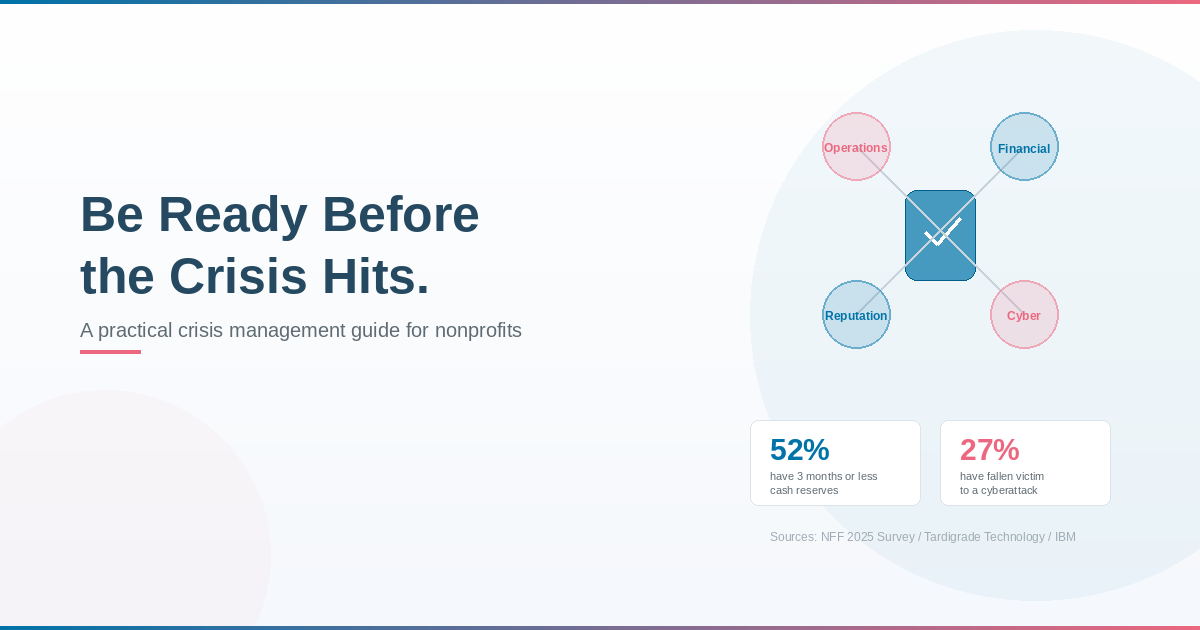
The Nonprofit Finance Fund’s 2025 survey found that 86% of nonprofits said high costs due to inflation have negatively affected their organizations and the communities they serve. Over half of respondents (52%) reported having three months or less of cash reserves on hand, with 18% holding just one month or less. When a major funder pulls back or a grant is delayed, organizations without adequate reserves can find themselves in trouble within weeks.
Financial experts recommend that nonprofits maintain three to six months of operating expenses in reserve. However, the data shows that the majority of nonprofits fall short of that benchmark, leaving a dangerously thin margin for absorbing unexpected shocks.
Cybersecurity incidents
This is the crisis category growing fastest, and the one many nonprofits are least prepared for.
Nonprofits are among the most frequently targeted sectors for cyberattacks. A 2025 BDO analysis found that nonprofits experienced a 30% year-over-year increase in the number of weekly cyberattacks in 2024. The reasons are straightforward: nonprofits hold sensitive donor and beneficiary data, often operate with limited IT resources, and may lack formal cybersecurity policies.
Research from Tardigrade Technology found that 27% of nonprofits have already fallen victim to at least one cyberattack, and 35% of nonprofit leaders admit they are unprepared for cybersecurity challenges. The average global cost of a data breach reached $4.88 million in 2024, a 10% increase from the prior year, according to IBM’s annual Cost of a Data Breach report.
For nonprofits, the financial cost is only part of the damage. Research shows that 80% of donors say they would stop or hold off on donations after learning about a data breach at a charity they support. A single cybersecurity incident can erode the trust that took years to build.
Reputational crises
Leadership misconduct, misuse of funds, a poorly handled public statement, or even a social media misunderstanding can spiral into a full reputational crisis. In the age of social media, these situations escalate faster than ever.
The Give.org Donor Trust Report found that the top accountability priorities for donors include how a charity spends its money and whether fundraising appeals are honest. When trust is broken, donors do not wait for explanations. They leave.
On the positive side, 93% of donors trust nonprofits and charities as ethical organizations. That baseline trust is a powerful asset, but it requires active maintenance and honest communication, especially during difficult moments.
Natural disasters and operational disruptions
Hurricanes, floods, wildfires, pandemics, and infrastructure failures can disrupt nonprofit operations overnight. For organizations that deliver direct services, these events create a double challenge: the community needs your help more than ever, but your own operations may be compromised.
FEMA provides continuity planning templates and guidance specifically designed for non-federal entities, including nonprofits and community-based organizations, emphasizing the importance of identifying essential functions and developing plans to maintain them during disruptions. Yet many nonprofits, particularly smaller ones, have no business continuity plan at all.
Building a Crisis Management Plan: 6 Practical Steps
A crisis management plan does not need to be a 50-page binder collecting dust on a shelf. The best plans are concise, practical, and regularly updated. Here is how to build one.
Step 1: Identify your most likely risks
Start by assessing which types of crises your organization is most vulnerable to. A nonprofit that depends heavily on government grants faces different risks than one that relies on individual donors. An organization with a large volunteer base has different exposure than one with a small, paid staff.
Consider financial risks, operational risks, reputational risks, cybersecurity risks, and compliance risks. Prioritize the risks that are most likely to occur and would have the greatest impact on your mission. The Grassi survey found that rising costs and increased demand are the two pressures hitting the most organizations right now, so financial resilience should be near the top of every nonprofit’s risk list.
Step 2: Build a crisis response team
Designate a small group of people who will be responsible for managing any crisis. This typically includes your executive director, a board member, your communications lead, and a senior program staff member. Every person on the team should know their role before a crisis happens, not during one.
Assign clear responsibilities: who makes decisions, who communicates with the public, who contacts donors, who handles logistics. Having these roles defined in advance prevents the confusion and delays that turn manageable situations into disasters.
Step 3: Create a communication plan
How you communicate during a crisis matters as much as what you do. Donors, volunteers, and community members look to you for honesty and clarity. Going silent or appearing evasive almost always makes the situation worse.
Your communication plan should cover:
Internal communication. Your staff and volunteers should hear from you before they hear from anyone else. Uncertainty breeds anxiety, and anxious team members cannot serve your community effectively.
Donor communication. Be honest about what happened, what you are doing about it, and how it affects your mission. Donors are more forgiving than most organizations expect, but only when they feel respected enough to be told the truth.
Public communication. Prepare template statements for common crisis scenarios that can be quickly customized. Designate a single spokesperson to ensure consistent messaging. Avoid the temptation to go silent and hope the situation resolves itself.
Media communication. If your crisis attracts media attention, have a media response protocol in place. Stick to facts, express empathy, and focus on the steps you are taking to address the situation.
Step 4: Protect your data and systems
Given that nonprofits experienced a 30% increase in weekly cyberattacks in 2024 alone, data protection is a non-negotiable part of any crisis plan.
Start with the basics: ensure your team uses strong, unique passwords and enable multi-factor authentication on all accounts. BDO’s analysis found that 68% of breaches involved a human element, such as phishing or human error. That means your security is only as strong as your team’s awareness.
Back up your data regularly and test your backups. Maintain an inventory of the systems and vendors that have access to your data. Train your staff to recognize phishing emails, which remain the most common entry point for cyberattacks.
If you use a cloud-based CRM or donor management system, make sure it provides enterprise-grade security features including data encryption, role-based access controls, automatic backups, and compliance with data protection regulations.
Step 5: Build financial resilience
Financial preparedness is the foundation that supports every other part of your crisis plan. Without adequate reserves, even a minor disruption can become an existential threat.
Work toward building three to six months of operating reserves. If that feels out of reach, start with a goal of one month and build from there. The Nonprofit Finance Fund found that among repeat survey respondents, the share maintaining six or more months of reserves dropped from 36% to 26%, reflecting the financial pressure many organizations are under.
Diversify your revenue sources so that no single funder or funding stream represents a make-or-break dependency. Organizations that rely on a mix of individual donations, grants, events, and earned revenue are far more resilient than those dependent on a single source.
Review your insurance coverage annually and make sure it accounts for your current operations, not the operations you had when you first bought the policy.
Step 6: Test, update, and practice
A crisis plan that nobody has practiced is barely better than no plan at all. Schedule at least one tabletop exercise per year where your crisis team walks through a realistic scenario and practices their response.
After any real incident, no matter how small, conduct a post-incident review. What worked? What did you learn? What needs to change? Update your plan based on what you discover. Review your crisis management plan at least annually, and more frequently if your organization undergoes significant changes in leadership, programs, or technology.
How Technology Supports Crisis Preparedness
The right technology does not prevent every crisis, but it dramatically improves your ability to respond and recover.
A centralized CRM ensures that your donor data, communication history, and program records are all in one secure, accessible system. If a key staff member is suddenly unavailable, the rest of your team can still access the information they need to keep operations running.
Cloud-based systems provide built-in advantages for crisis resilience: automatic backups mean your data is protected even if your office is compromised, remote access means your team can work from anywhere during a disruption, and enterprise-grade security features protect against the cybersecurity threats that are increasingly targeting the nonprofit sector.
Automated communication tools allow you to quickly reach your donors, volunteers, and stakeholders with updates during a crisis, rather than scrambling to send individual emails or make phone calls.
GiveLife365 is a nonprofit CRM built on the Microsoft Power platform that brings donor management, volunteer coordination, event management, and case management together in one cloud-based system. Because it runs on Microsoft’s enterprise-grade infrastructure, your data is protected by the same security standards used by governments and Fortune 500 companies, including data encryption, role-based access controls, and automatic backups. That means one less thing to worry about when the unexpected happens.
The Organizations That Bounce Back
Every nonprofit will face a crisis at some point. The difference between the organizations that struggle and the ones that emerge stronger comes down to preparation.
You do not need a perfect plan. You need a plan that exists, that your team understands, and that you practice and update regularly. Start with the risk that keeps you up at night, whether that is a funding disruption, a data breach, or a natural disaster, and build your preparedness from there.
The organizations that invest in crisis planning are not just protecting themselves. They are protecting the communities and causes that depend on them.
Ready to strengthen your nonprofit’s foundation? Book a free demo of GiveLife365 and see how a secure, cloud-based CRM can help your team stay connected, protect your data, and keep your mission running no matter what comes your way.
