


Grants can be a game-changer for nonprofits. Unlike donations that come in small, ongoing amounts, a single grant can fund an entire program, upgrade your technology, or help you expand into a new community. But finding and winning grants, especially federal grants, takes preparation, patience, and a solid strategy.
If you have ever wondered where to start, how the process works, or what makes a successful application, this guide is for you. We will walk through everything from where to find Canadian federal grants to how to put together a strong proposal that stands out.
The Canadian Nonprofit Landscape: Why Grants Matter
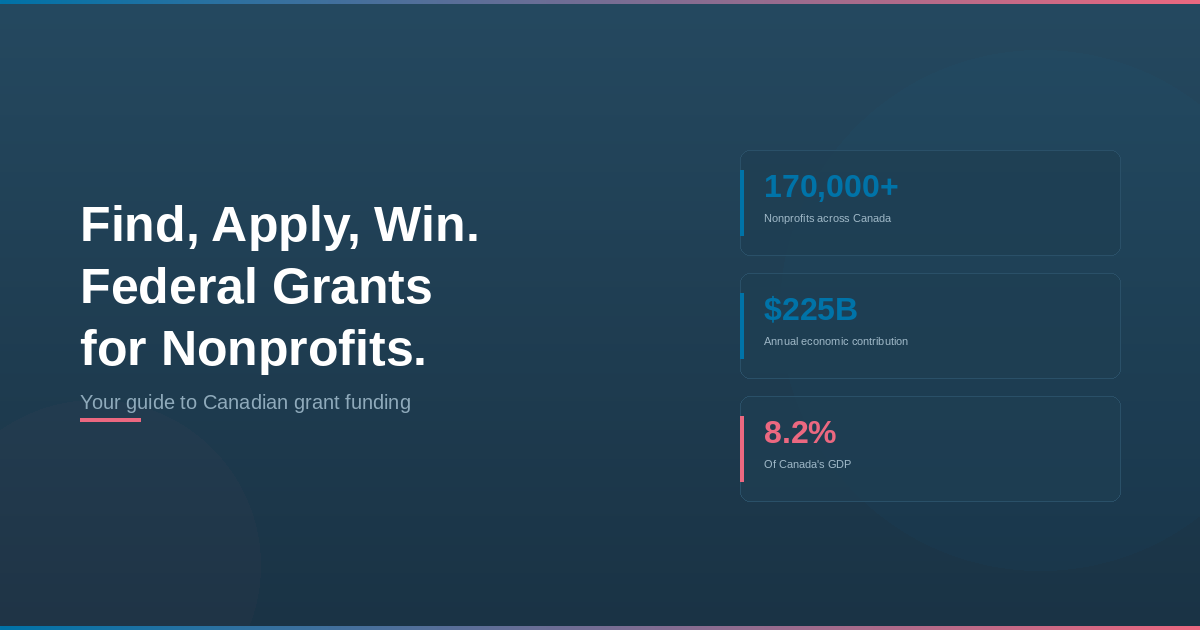
Canada’s nonprofit sector is massive. There are over 170,000 charitable and nonprofit organizations operating across the country, of which roughly 86,000 are registered charities with the Canada Revenue Agency. Together, these organizations contribute about $225 billion in economic activity, representing 8.2% of Canada’s GDP, and employ more than 2.7 million people, according to Imagine Canada.
But here is the challenge: demand for nonprofit services is rising sharply. According to a 2025 report by the Nonprofit Chamber, drawing on Statistics Canada survey data, 62% of charities report increasing demand for their services, while 72% of nonprofits say their capacity has stayed the same or decreased. Food bank visits hit record levels in March 2025, double what they were in March 2019.
For many organizations, government grants are a critical funding source. Government revenue across all levels (federal, provincial, and municipal) totals over $200 billion for the registered charity sector, making it the single largest source of revenue for many nonprofits. Federal grants, in particular, represent a significant opportunity, with billions allocated each year across hundreds of programs.
What Are Federal Grants?
Grants are funds given to organizations for a specific purpose, usually tied to a program, project, or initiative. Unlike loans, grants do not need to be repaid.
Grants are typically categorized by the institution that provides the funding:
– Government grants: Federal, provincial, or municipal
– Foundation grants: From private or community foundations
– Corporate grants: From businesses with social responsibility programs
In this guide, we are focusing on federal grants, which are those funded by the Government of Canada. These grants support everything from community programs and social services to accessibility improvements, employment initiatives, and technology upgrades.
Federal grants vary widely in size. Some are smaller, like Canada Summer Jobs wage subsidies of $15,000 to $30,000. Others are much larger. For example, the Enabling Accessibility Fund’s 2026 call for proposals increased its funding range to $500,000 to $1,000,000 for mid-sized and major accessibility projects.
Before You Start: Ask Yourself the Right Questions
Jumping straight into a grant search without preparation is one of the most common mistakes nonprofits make. Before you look at a single application, take time to think through the following questions:
– What specific program, project, or need am I seeking funding for?
– What is my estimated budget, and how will the funds be used?
– Do I have data that shows the impact of our past programs?
– Which communities and provinces does my nonprofit serve?
– What type of grant do I need? Is it for operations, a specific program, technology, equipment, or a special initiative?
The clearer you are about what you need and why, the easier it will be to find grants that match and to write a convincing application. Imagine Canada’s grant writing guidance encourages nonprofits to treat this preparation step seriously, because vague or mismatched applications are one of the top reasons proposals get rejected.
Where to Find Federal Grants in Canada
Once you know what you are looking for, here is where to search.
Government of Canada Grants and Funding Portal
The Government of Canada maintains a central directory of grants and funding opportunities at canada.ca/grants-funding. This is the best starting point. You can browse by department, topic, or eligibility criteria. Key federal programs include:
– Canada Summer Jobs: Wage subsidies to help nonprofits hire summer students for program delivery.
– Enabling Accessibility Fund: Funding for projects that improve accessibility in communities and workplaces.
– Canada Council for the Arts: Explore and Create project grants ranging from $30,000 to $150,000 for artistic and cultural programming.
– Canada Fund for Local Initiatives: With an annual budget of $26.8 million, supporting community projects that average $31,000 each.
– Employment and Social Development Canada (ESDC): Various funding opportunities tied to jobs, training, and social development.
Provincial and Regional Programs
Beyond federal programs, do not overlook provincial and regional funding. In Ontario, for example, organizations like the Ontario Trillium Foundation, FedDev Ontario (formerly FedNor for Northern Ontario), and the Eastern Ontario Development Fund provide significant grant opportunities. Every province and territory has similar programs, so check your local government’s funding pages.
Community Foundations
Canada has a network of community foundations that provide grants to local nonprofits. Community Foundations of Canada maintains a directory of foundations across the country. These are often a great fit for smaller organizations focused on local impact.
Grant Directories
Online directories can help you search for grant opportunities in one place. Some useful ones include:
– Grant Connect by Imagine Canada: A paid subscription tool that matches nonprofits with relevant funders.
– Open Government Grants and Contributions: A searchable database of federal government grants and contributions.
– GrantWatch Canada: Aggregates grant listings from various sources.
Set Up Alerts
Here is a simple tip many nonprofits overlook: set up Google Alerts for keywords related to your funding needs. For example:
– “Federal grants for nonprofits Canada”
– “Government funding for charities [your province]”
– “Technology grants for nonprofits Canada”
This way, new opportunities come to you instead of requiring you to search manually every week.
How to Write a Winning Grant Proposal
Finding the right grant is only half the battle. You also need to put together a proposal that stands out from the many applications funders receive.
Here is what goes into a strong grant application.
1. Read the instructions carefully
This sounds obvious, but it trips up more applicants than you might expect. Every funder has specific guidelines about what they want to see, how the proposal should be formatted, and what supporting documents are needed. Imagine Canada’s grant writing experts stress that following instructions precisely is one of the simplest and most important things you can do.
2. Customize every application
A generic, copy-paste proposal rarely wins. Funders can tell when an application was not written specifically for them. Take the time to understand each funder’s priorities and show clearly how your project aligns with their mission. As Imagine Canada notes, you will get better results spending time on one customized application than rushing through several generic ones.
3. Lead with impact, not process
Funders want to know what will change because of your project. They care less about your day-to-day activities and more about the outcomes. Frame your proposal around the problem you are solving, the people you are helping, and the measurable results you expect to achieve. Use phrases like “This project will reduce wait times for 200 families” rather than “We plan to expand our intake process.”
4. Back it up with data
Numbers build credibility. Include data about the community need you are addressing, the results of your past programs, and the specific metrics you will use to measure success. Imagine Canada advises that including data points and case studies provides real-world evidence of your organization’s track record and builds funder confidence.
This is where having a good data tracking system makes a big difference. If you can show funders a clear picture of what you have accomplished before, with real numbers, your application becomes much more compelling.
5. Prepare a detailed, realistic budget
Many funders say the budget is the first section they read. It tells them whether you understand the true cost of the project and whether you are being realistic. List every expense: direct costs like salaries, materials, and equipment, as well as indirect costs like administration and overhead. If you have other funding sources or in-kind contributions, include those too.
6. Start early and stay organized
Grant applications take time. Between gathering data, writing the narrative, preparing a budget, collecting letters of support, and compiling financial statements, the process can be substantial. Starting early gives you room to revise, get feedback, and submit a polished application rather than a rushed one.
Managing Grants After You Win Them
Winning a grant is exciting, but the work does not stop there. Most federal grants come with reporting requirements, milestones, and deadlines. You need to track how funds are being spent, measure the progress of your project, and submit reports to the funder on time.
This is where many nonprofits struggle, especially those still relying on spreadsheets or disconnected tools. A CRM with grant management capabilities can help you stay on top of the entire grant lifecycle, from the moment you discover a funding opportunity to the final impact report.
GiveLife365, for example, includes a grant management module designed for nonprofits. It helps you track applications, manage deadlines through task-based workflows, monitor fund disbursement, and report on outcomes, all from one system. The platform’s analytics capabilities, powered by Microsoft Power BI, turn your program data into visual reports that make it easier to demonstrate impact to funders. When your next grant application asks for evidence of past success, having clean, organized data ready to go gives you a real edge.
Set SMART Goals to Strengthen Your Applications
One last piece of advice: frame your project objectives using the SMART framework:
– Specific: What exactly will you achieve?
– Measurable: How will you track progress?
– Achievable: Is this realistic given your resources?
– Relevant: Does it align with your mission and the funder’s priorities?
– Time-bound: What is your timeline?
Funders like to see that you have thought through not just what you want to do, but how you will know when you have succeeded. SMART goals show that level of planning and accountability.
Your Next Step
Grants are not reserved for large, well-established nonprofits. Organizations of every size win federal grants in Canada, and many programs are specifically designed for smaller community groups. The key ingredients are preparation, strong data, and a proposal that clearly connects your mission to the funder’s goals.
Start by exploring the Government of Canada’s grants portal, then spend time getting your data and internal records in order. If you are looking for a tool that brings your donor data, volunteer information, program results, and grant management into one place, book a free demo of GiveLife365 and see how the right CRM can make your next application stronger.
